SEM Tips, Benefits, How It Relates to SEO

Search engine optimization and search engine marketing can be a confusing concept to grasp. Is there even a difference between them?

Both terms are often used interchangeably, which makes matters even worse.

Access Now: 20 SEO Myths to Leave Behind in 2020

It is important to understand the difference between the two terms and that they are different.

In this post, I will help clear up this issue with some frequently asked questions that I have heard from others.

What is SEM?

SEM, or search engine marketing, is a marketing tactic where a marketer optimizes and advertises their website in order to appear higher in search results.

According to a deeper Wikipedia definition, “Search engine marketing is a form of Internet marketing that involved the promotion of websites by increasing their visibility in search engine results pages (SERPS) through optimization and advertising.”

SEO is increasing the amount of website visitors by getting the site to appear high on results returned by a search engine. SEM is considered internet marketing that increases a site’s visibility through organic search engines results and advertising. SEM includes SEO as well as other search marketing tactics.

What is the benefit of SEM?

While SEO allows you to optimize your website for a greater chance in appearing higher in search results, and online advertising allows you to send promotional content to the target audience of your choosing, SEM combines both benefits as your content is both optimized for higher search rankings and is placed primarily in front of audiences who are most likely to convert when they click on your ads.

Is paid search the same as SEM?

At this point, you might be asking, “If I can pay for my website to appear higher in search results, how is SEM different from paid search?” Well, paid search is a major aspect of SEM and refers to pay-per-click (PPC) ads specifically. However, the two strategies are different.

The key distinction is that SEM is a broader strategy which combines paid search and SEO tactics. So, if you set up a PPC advertisement, but don’t take steps to optimize the ad or the website it links to, this is a standard example of paid search. However, if you optimize your site and your search content with solid keywords, then you put money behind it to boost it on targeted audience’s search pages, then you’re dabbling in SEM.

What components does SEM include?

As noted above, other than search engine optimization, SEM includes the use of paid search, such as pay per click (PPC) listings and advertisements. Most of the time, SEM strictly includes PPC campaigns and activities, but if you use SEO and paid search, that falls under SEM efforts.

What Is Search Engine Optimization (SEO)?

SEO is essentially a component of the larger category, SEM. According to Google’s Knowledge Graph, search engine optimization is “the process of maximizing the number of visitors to a particular website by ensuring that the site appears high on the list of results returned by a search engine.”

The SEO industry is continually changing due to the frequent changes made to Google’s algorithm. But, there is one aspect of SEO that stays constant: SEO is made up of On-Page and Off-Page activities.

What components does SEO include?

As stated above, SEO is comprised of two different activities:

  • Incorporating selective keyword naturally into title tags, meta descriptions, heading tags, alt text, etc.

  • Blog posts and page copy that is written and optimized with quality

  • Clean and formatting page URLS

  • Optimized page load speed

  • Google authorship incorporated

  • Social sharing integration within your content

  • And much more!

What components does off-page SEO include?

  • Creating a high quality, natural backlink profile (aka having other high quality/authoritative sites  link to your site naturally)

  • Social sharing signals

  • Social bookmarking (Stumbleupon, Reddit)

  • List goes on here too!

Which is better: SEO or SEM?

The main difference between these two terms is that search engine optimization is simply a component of search engine marketing. As mentioned above, SEM includes components of paid search, such as PPC and also SMM (social media marketing).

It is important to note that you should never use the terms SEO and SEM interchangeably, because although they work hand in hand, they are not the same term.

The Bottom Line

Many marketers debate whether one is better than the other. As an Inbound Marketer, I would argue that organic SEO is the best approach, but as you can see, true SEM cannot succeed without the use of organic SEO.

Additionally, there are many situations where PPC (a component of SEM) makes more sense than SEO. For example, if you are first launching a site and you want immediate visibility, it is a good idea to create a PPC campaign because it takes less time than SEO, but it would be unwise to strictly work with PPC and not even touch search engine optimization.

Although organic SEO takes longer to show results, in the end it will be less costly and you will establish a search credibility that you might not establish with PPC.

When it comes to choosing the best tactic, it is important to evaluate your specific needs, but be sure to fully understand the differences and how you will maintain your efforts. Check out Revenue River’s free guide for how SEO how-to.

Editor’s Note: This blog post was originally posted in January 2014, but was updated in January 2020 for comprehensiveness.

seo myths

Originally published Jan 3, 2020 10:00:00 AM, updated April 16 2020

Don’t forget to share this post!

Source

Is the new Google Guarantee program worth the hassle

Avery Swartz

Special to The Globe and Mail

This article was published more than 1 year ago. Some information in it may no longer be current.

Comments

Avery Swartz is a tech consultant whoadvises small businesseson all things digital. She is also the founder ofCamp Tech, a tech training company for businesses and individuals across Canada.

Alphabet Inc.’s Google has rolled out a new service in Canada that promises to help your professional service business stand out from the crowd. Businesses in the program will have Google’s badge of approval next to their listing in the search engine’s results. The program says it will drive new business leads, but is it worth the cost and the hassle?

The Google Guarantee program is a feature of the company’s Local Services ads service, which launched in Canada in late 2018 in the Toronto and Vancouver areas. The program is currently only available in Canada for plumbers, heating, ventilation and air conditioning (HVAC) professionals and locksmiths, but is expected to be rolled out for other service providers down the road.

Google started testing Local Services ads in San Francisco in 2015 and has expanded to more than 30 metropolitan areas in the United States. In the United States, Local Services ads are available for service categories including locksmiths, plumbers, electricians, HVAC services, carpet cleaners, house cleaners and garage door services.

Local Services ads are similar to Google Ads (previously called Google AdWords), in that they appear at the top of search engine result pages when someone is doing an internet search. Businesses only pay Google when a lead is generated through Local Services ads. Google provides a forwarding phone number in the ad, and leads are tracked through those phone calls.

If privacy is top of mind for your business, be warned: A recent Star Metro report says both sides of the phone calls are recorded by Google. The service provider is only charged for the calls that come through from Google and can set a weekly budget based on the average number of leads they’d like to receive.

Unlike Google Ads, which anyone can create, Local Services ads have a detailed application process. Google vets each service provider, verifying that they have insurance and meet all local licence requirements. They also perform background checks on the business and the owner. Jumping through the extra hoops can be worthwhile, though, as the end result is an ad in Google with a special designation: a “Google Guarantee.”

When a customer books through Google Local Services, the service is “Google Guaranteed” for up to $2,000 money back if the customer is unhappy. The Google Guarantee badge appears right in the ad itself.

On the customer side, the Google Guarantee is compelling. Odds are, when someone is searching for a plumber, HVAC or locksmith service, they’re in a moment of need. They have a problem, need it fixed fast, and are likely to book a service right away. It can be hard for the customer to determine who’s trustworthy in a Google search though, as reputable service providers have to compete against shady businesses who may be buying Google Ads to stand out. Service providers with a Google Guarantee designation appear first in search results (higher than Google Ads). This helps instill customer trust and provide peace of mind.

Brock Murray is co-founder and chief operating officer of seoplus+, an Ottawa-based digital marketing agency. He has been following the rollout of Local Services ads in the United States and is excited to see them launch in Canada. He sees the appeal in Local Service ads, particularly because of their ease of use. “I like that from business owner’s perspective, it’s really simple to use,” Mr. Murray says. “It’s a very easy way to get leads at a predictable cost.”

Mr. Murray suspects that Google will expand the types of professional service businesses eligible for Local Services ads beyond the plumbing, HVAC and locksmith industries into other services as they’ve done in the United States. He encourages businesses to try Local Service ads as early as they can, as being one of the first service providers to have the Google Guarantee can be a key differentiator against competition. “The first ones who get Google Guaranteed are going to be getting the traffic. If you’re not, you’re going to fall behind,” Mr. Murray advises.

Lior Shaykevich, owner of Toronto Pro Locksmith, has experimented with Local Services ads. “It’s fantastic. It gets me to the top and shows the actual businesses that are capable of doing the job and makes me stand out,” he says. Mr. Shaykevich was able to set up his Google Local Services account himself, and spending about $400 a week, he says he is receiving an estimated five calls a day.

That’s a relatively low cost for each lead when compared with Google Ads, where it can cost a business $30 to $40 for each lead-generating click to appear at the top of a search for “Toronto locksmith.” As more businesses sign up for Google Local Services ads, the cost to compete could rise. “As more people get on it, that’s when they’ll drive up the prices. Just like AdWords five years ago,” Mr. Murray says.

Source

The Ultimate Guide to Google Ads for 2020

If you’re considering spending any amount of money on ads to reach your target audience, then you’d better spend it in the right place. That is, somewhere with over 246 million unique visitors, 3.5 billion daily interactions, and an estimated 700% return on investment.

Somewhere like… Google Ads.

Google Ads was launched just two years after what has become the most popular website in the world: Google.com. The advertising platform came on the scene in October 2000 as Google Adwords, but after some rebranding in 2018, it was renamed Google Ads. Given Google’s expansive reach, chances are you’ve seen (and probably clicked on) a Google ad … and so have your potential customers.

In this guide you’ll discover what Google Ads is and what you need to know to begin advertising on Google. We’ll cover features specific to the platform and teach you how to optimize your campaigns to achieve the best results with your ads.


  1. What is Google Ads?


  2. Why Advertise on Google?


  3. Google Ads Terms to Know


  4. How Does Google Ads Work?


  5. How to Set Up Google Ads


  6. Google Ads Bidding Strategies

What is Google Ads?

It’s no secret that, these days, the stronger and more focused your paid campaigns are, the more clicks you generate — leading to a greater probability of obtaining new customers. This is why Google Ads has become increasingly popular among businesses across all industries.

Google Ads is a paid advertising platform that falls under a marketing channel known as pay-per-click (PPC), where you (the advertiser) pays per click or per impression (CPM) on an ad.

Free Guide, Template & Planner: How to Use Google Ads for Business

Google Ads is an effective way to drive qualified traffic, or good-fit customers, to your business while they’re searching for products and services like the ones you offer. With Google Ads, you can boost your website traffic, receive more phone calls, and increase your in-store visits. 

Google Ads allows you to create and share well-timed ads (via both mobile and desktop) among your target audience. This means your business will show up on the search engine results page (SERP) at the moment your ideal customers are looking for products and services like yours via Google Search or Google Maps. This way, you reach your target audience when it makes sense for them to come across your ad. 

Note: Ads from the platform can span across other channels too, including YouTube, Blogger, and Google Display Network.

Over time, Google Ads will also help you analyze and improve those ads to reach more people so your business can hit all of your paid campaign goals

Additionally, no matter the size of your business or your available resources, you can tailor your ads to suit your budget. The Google Ads tool gives you the opportunity to stay within your monthly cap and even pause or stop your ad spending at any point in time.

Discover how HubSpot can help you better manage your Google ads.

Now, onto another important question: Is Google Ads really effective?

Does Google Ads work?

To answer this, let’s consider a few statistics. Google Ads have a click-through rate of nearly 8 percent. Display ads yield 180 million impressions each month. For users who are ready to buy, paid ads on Google get 65% of the clicks. 43% of customers buy something they’ve seen on a YouTube ad. So, yes, Google Ads works. With an optimized ad campaign and lead flow, you can create a high-ROI marketing campaign.

Why advertise on Google?

Google is the most used search engine, receiving 3.5 billion search queries a day. Not to mention, the Google Ads platform has been around for nearly two decades, giving it some seniority in the area of paid advertising. Google is a resource used by people around the world to ask questions that are answered with a combination of paid advertisements and organic results.

And, according to Google, advertisers make $8 for every $1 they spend on Google Ads. So, there are a few reasons why you’d want to consider advertising on Google.

Need another reason? Your competitors are using Google Ads (and they might even be bidding on your branded terms). Thousands of companies use Google Ads to promote their businesses, which means that even if you’re ranking organically for a search term, your results are being pushed down the page, beneath your competitors.

If you’re using PPC to advertise your product or services, Google Ads should be a part of your paid strategy — there’s no way around it (except maybe Facebook Ads, but that’s another article).

Reasons Why Your Google Ads Aren’t Working

If you’ve tried unsuccessfully to advertise on Google, don’t give up. There are many reasons why your Google Ads could be underperforming. Let’s cover some common offenders.

  1. Broad Keyword Terms. You really need to nail it when it comes to your keywords, which is why testing and tweaking should be a part of your strategy. If your keywords are too broad, Google will be placing your ad in front of the wrong audience which means fewer clicks and a higher ad spend. Review what’s working (i.e. which keywords are generating clicks) and adjust them to best match your ads with your target audience. You likely won’t get the mix right the first time but you should keep adding, removing, and tweaking keywords until you do.
    How to fix it: Review the keyword strategies that we cover below.
  2. Irrelevant Ads. If your ad doesn’t match the searcher’s intent, you won’t get enough clicks to justify your ad spend. Your headline and ad copy need to match the keywords you’re bidding on, and the solution your ad is marketing needs to solve whatever pain point that searcher is experiencing. It’s a combination that will yield the results you’re looking for, and it may just be a few tweaks away. You have the option to create multiple ads per campaign — use this feature to split test which ads work best. Or, better yet, us
    e Google’s Responsive Search Ads feature.
    How to fix it: Read our best practices for ad copy.
  3. Low Quality Score. Your Quality Score (QS) is how Google determines how your ad should rank. The higher your rank, the better your placements. If your quality score is low, you’ll have fewer eyeballs on your ad and fewer chances to convert. Google will tell you your Quality Score, but improving it is up to you.
    How to fix it: Keep reading to learn how to improve your QS.
  4. Poor Landing Page. Your efforts shouldn’t stop with your ad — the user experience after a click is equally important. What does your user see once they click your ad? Is your landing page optimized for conversions, meaning does it use the same keywords? Does the page solve your user’s pain point or answer their question? Your user should experience a seamless transition through to the conversion.
    How to fix it: Review landing page best practices and implement them to increase your conversion rate.

Google Ads Terms to Know

  1. AdRank
  2. Bidding
  3. Campaign Type
  4. Click-Through Rate
  5. CPC
  6. CPM
  7. Conversion Rate
  8. Display Network
  9. Ad Extensions
  10. Keywords
  11. PPC
  12. Quality Score

These common terms will help you set up, manage, and optimize your Google Ads. Some of these are specific to Google Ads, while others are related to PPC in general. Either way, you’ll need to know these to run an effective ad campaign.

AdRank

Your AdRank determines your ad placement. The higher the value, the better you’ll rank, the more eyes will fall on your ad, and the higher the probability that users will click your ad. Your AdRank is determined by your maximum bid multiplied by your Quality Score.

Bidding

Google Ads is based on a bidding system, where you as the advertiser selects a maximum bid amount you’re willing to pay for a click on your ad. The higher your bid, the better your placement. You have three options for bidding: CPC, CPM, or CPE.

  • CPC, or cost-per-click, is the amount you pay for each click on your ad.
  • CPM, or cost per mille, is the amount you pay for one thousand ad impressions, that is when your ad is shown to a thousand people.
  • CPE, or cost per engagement, is the amount you pay when someone takes a predetermined action with your ad.

And, yes, we’ll review bidding strategies below.

Campaign Type

Before you begin a paid campaign on Google Ads, you’ll select between one of three campaign types: search, display, or video.

  • Search ads are text ads that are displayed among search results on a Google results page.
  • Display ads are typically image-based and are shown on web pages within the Google Display Network.
  • Video ads are between six and 15 seconds and appear on YouTube.

Click-Through Rate (CTR)

Your CTR is the number of clicks you get on your ad as a proportion of the number of views your ad gets. A higher CTR indicates a quality ad that matches search intent and targets relevant keywords.

Conversion Rate (CVR)

CVR is a measure of form submissions as a proportion of total visits to your landing page. Simplistically speaking, a high CVR means that your landing page presents a seamless user experience that matches the promise of the ad.

Display Network

Google ads can be displayed on either search results pages or a web page within Google’s Display Network (GDN). GDN is a network of websites that allow space on their webpages for Google Ads — these ads can be text-based or image ads and are displayed alongside content relevant to your target keywords. The most popular Display Ad options are Google Shopping and app campaigns.

Extensions

Ad Extensions allow you to supplement your ad with additional information at no additional cost. These extensions fall under one of five categories: Sitelink, Call, Location, Offer, or App; we’ll cover each of these ad extensions below.

Keywords

When a Google user types a query into the search field, Google returns a range of results that match the searcher’s intent. Keywords are words or phrases that align with what a searcher wants and will satisfy their query. You select keywords based on which queries you want to display your ad alongside. For example, a searcher that types “how to clean gum off shoes” will see results for advertisers that targeted keywords like “gum on shoes” and “clean shoes.”

  • Negative Keywords are a list of keyword terms that you do not want to rank for. Google will pull you from the bid on these keywords. Typically, these are semi-related to your intended search terms but fall outside of the realm of what you offer or want to rank for.

PPC

Pay-per-click, or PPC, is a type of advertising where the advertiser pays per click on an ad. PPC is not specific to Google Ads, but it is the most common type of paid campaign. It’s important to understand the ins and outs of PPC before launching your first Google Ads campaign.

Quality Score (QS)

Your Quality Score measures the quality of your ad by your click-through rate (CTR), the relevance of your keywords, the quality of your landing page, and your past performance on the SERP. QS is a determining factor in your AdRank.

Click to get our free guide on how to use Google Ads.

How does Google Ads work?

Google Ads displays your ad to potential leads or customers who are interested in your product or service. Advertisers bid on search terms, or keywords, and the winners of that bid are placed at the top of search results pages, on YouTube videos, or on relevant websites, depending on the type of ad campaign selected.

Many factors impact your ability to create effective and high-performing Google Ads. Let’s cover them below.

AdRank and Quality Score

AdRank determines the placement of your ads, and Quality Score is one of the two factors (the other being bid amount) that determines your AdRank. Remember, your Quality Score is based on the quality and relevance of your ad, and Google measures that by how many people click on your ad when it’s displayed — i.e. your CTR. You CTR depends on the how well your ad matches searcher intent, which you can deduce from three areas:

  1. The relevance of your keywords
  2. If your ad copy and CTA deliver what the searcher expects based on their search
  3. The user experience of your landing page

Your QS is where you should focus most of your attention when you first set up your Google Ad campaign — even before you increase your bid amount. The higher your QS, the lower your acquisition costs will be and the better placement you’ll get.

Ad Campaign Types: Search, Display, and Video

You can select from one of three campaign types on Google Ads: search, display, or video. Let’s cover the optimal uses for each and why you might choose one over the other.

Search Ads

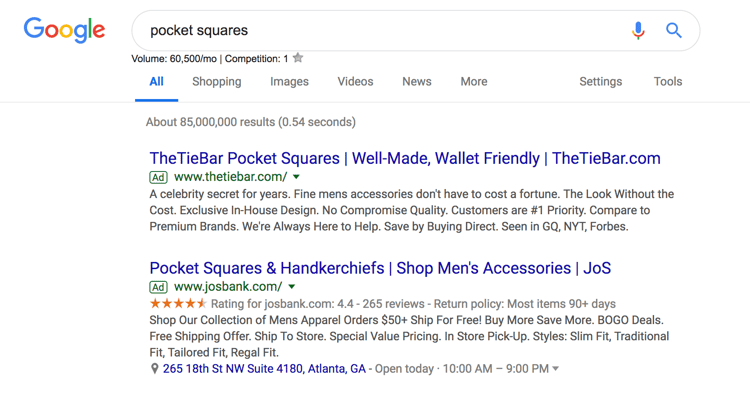
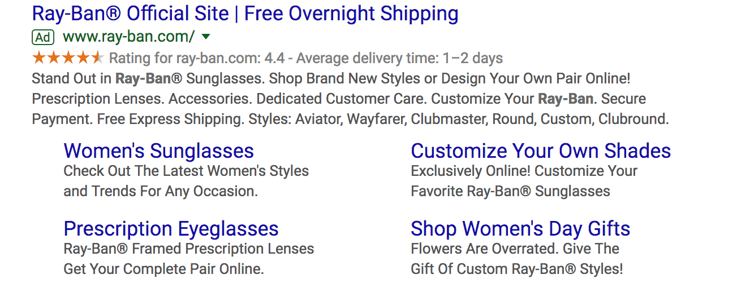
Search ads are text ads that are displayed on Google results pages. As an example, a search for “pocket squares” returns sponsored results, or ads, like these:

google ads search ads

The benefit of search ads is that you’re displaying your ad in the place where most searchers look for information first — on Google. And Google shows your ad in the same format as other results (except for denoting it as an “Ad”) so users are accustomed to seeing and clicking on results.

Responsive Search Ads

Responsive search ads allow you to enter multiple versions of headlines and ad copy (15 and four variations, respectively) for Google to select the best performers to display to users. With traditional ads, create one static version of your ad, using the same headline and description each time. Responsive ads allow for a dynamic ad that is auto-tested until you arrive at the version that is best suited for your target audience — for Google, that means until you get the most clicks.

Display Ads

Google has a network of websites in various industries and with an array of audiences that opt in to display Google Ads, known as the Google Display Network. The benefit to the website owner is that they’re paid per click or impression on the ads. The benefit to advertisers is that they can get their content in front of audiences that are aligned with their personas. These are typically image ads that draw users attention away from the content on the webpage.

google ads display adSource

Additional options for Display Ads include shopping campaigns and app campaigns, which are displayed on search engine results pages.

Video Ads

Video ads are displayed before or after (and sometimes in the middle of) YouTube videos. Remember, YouTube is a search engine, too. The right keywords will place you in front of a video, disrupting the user’s behavior just enough to grab their attention.

Location

When you first set up your Google Ad, you’ll select a geographical area where your ad will be shown. If you have a storefront, this should be in a reasonable radius around your physical location. If you have an ecommerce store and a physical product, your location should be set in the places where you ship. If you provide a service or product that is accessible worldwide, then the sky’s the limit.

Your location settings will play a role in placement. For instance, if you own a yoga studio in San Francisco, someone in New York that enters “yoga studio” will not see your result, no matter your AdRank. That’s because Google’s main objective is to display the most relevant results to searchers, even when you’re paying.

Keywords

Keyword research is just as important for paid ads as it is for organic search. Your keywords need to match searcher intent as much as possible. That’s because Google matches your ad with search queries based on the keywords you selected. Each ad group that you create within your campaign will target a small set of keywords (one to five keywords is optimal) and Google will display your ad based on those selections.

Match Types

Match Types give you a little wiggle room when it comes to your keyword selections — they tell Google whether you want to match a search query exactly or if your ad should be shown to anyone with a search query that’s semi-related. There are four match types to choose from:

  • Broad Match is the default setting that uses any word within your keyword phrase in any order. For example, “goat yoga in Oakland” will match “goat yoga” or “yoga Oakland.”
  • Modified Broad Match allows you to lock in certain words within a keyword phrase by denoting them with a “+” sign. Your matches will include that locked-in word at the very least. For example, “+goats yoga in Oakland” could yield “goats,” “goats like food,” or “goats and yoga.”
  • Phrase Match will match with queries that include your keyword phrase in the exact order but may include additional words before or after it. For example, “goat yoga” can yield “spotted goat yoga” or “goat yoga with puppies.”
  • Exact Match maintains your keyword phrase as it is written in the exact order. For example, “goat yoga” will not show up if someone types “goats yoga” or “goat yoga class.”

If you’re just starting out and don’t know exactly how your persona will be searching, move from a broad match to a more narrow approach so you can test which queries yield the best results. However, since your ad will be ranking for many queries (some unrelated) you should keep a close eye on your ads and modify them as you can gain new information.

Headline and Description

Your ad copy can be the difference between a click on your ad and a click on your competitor’s ad. It’s important that your ad copy matches the searcher’s intent, is aligned with your target keywords, and addresses the personas pain point with a clear solution.

To illustrate what we mean, let’s review an example.

google ads copy

A search for “baby swim lessons” yielded this result. The copy is concise and uses the limited space wisely to convey their message and connect with their target audience.

The Swim Revolution knew to put the keyword in their headline so we instantly know that this ad matches what we’re looking for. The description tells us why this is the best option for swim lessons because it addresses the concerns of their persona — a parent looking to enroll their baby in a swim class.

They use words like “skills,” “fun,” “confidence,” and “comfort in the water” to ease our nerves about putting a baby in a pool and to prove to us that we will get what we want out of this class — an infant that can swim.

This kind of ad copy will get you clicks, but conversions will result from carrying this level of intention into your landing page copy.

Ad Extensions

If you’re running Google Ads, you should be using Ad Extensions for two reasons: they’re free, and they give users additional information and another reason to interact with your ad. These extensions fall within one of these five categories:

  • Sitelink Extensions extend your add — helping you stand out — and provide additional links to your site that offer users more enticing reasons to click.

    google ads sitelink extensions

  • Call Extensions allow you to incorporate your phone number in your ad so users have an additional (and instant) way to reach out to you. If you have a customer service team that is ready to engage and convert your audience, then include your phone number.

    google ads call extensions

  • Location Extensions include your location and phone number within your ad so Google can offer searchers a map to easily find you. This option is great for businesses with a storefront and it works well for the search query “…near me.”

    google ads location extensions

  • Offer Extensions work if you’re running a current promotion. It can entice users to click your ad over others if they see that your options are discounted compared to your competitors.

    google ads offer extensions

  • App Extensions provide a link to an app download for mobile users. This reduces the friction from having to perform a new search to find and download the app in an AppStore.

    google ads app extensions

Google Ads Retargeting

Retargeting, a.k.a. remarketing, in Google Ads is a way to advertise to users who have previously interacted with you onlin
e but have not yet converted. Tracking cookies will follow users around the web and target these users with your ads. Remarketing is effective since prospects need to see your marketing at least seven times before they become a customer. 

How to Set Up Your Google Ads

Setting up your paid campaigns on Google is relatively easy (and quick), mostly because the platform takes you through the setup and provides helpful hints along the way. Once you visit the Google Ads site and click “Start Now,” you’ll be taken through a series of steps to get your ads up and running. If you have your ad copy and/or images created, set up should take you no more than 10 minutes.

What may be less obvious are all the additional things you need to do to make sure your ads are optimally set up and easily trackable. Let’s cover these together. These are the steps you’ll take once your ads are submitted for review.

Link Google Analytics

You likely have Google Analytics set up on your website so you can track traffic, conversions, goals, and any unique metrics. You also need to link your Analytics account to Google Ads. Linking these accounts will make tracking, analyzing, and reporting between channels and campaigns much easier because you can view these events in one place.

Add UTM Codes

Urchin Tracking Module (UTM) codes are used by Google to track any activity associated with a specific link. You’ve probably seen them before — it’s the part of a URL that follows a question mark (“?”). UTM codes will tell you which offer or ad led to a conversion so you can track the most effective parts of your campaign. UTM codes make it easier to optimize your Google Ads since you know exactly what’s working.

The trick, though, is to add your UTM codes at the campaign level when you set up your Google Ads so you don’t have to do so manually for each ad URL. Otherwise, you can add them manually with Google’s UTM builder.

Set Up Conversion Tracking

Conversion tracking tells you exactly how many customers or leads you’ve acquired from your ad campaigns. It’s not mandatory to set up but, without it, you’ll be guessing the ROI of your ads. Conversion tracking allows you to track sales (or other activities) on your website, app installs, or calls from your ads.

Manage and organize your ads with our free Google Ads Kit and Templates.

Integrate Your Google Ads With Your CRM

There is something to be said about keeping all of your data in one place where you can track, analyze, and report on it. You already use your CRM to track contact data and lead flows. Integrating Google Ads with your CRM gives you the ability to track which ad campaigns are working for your audience so you can continue marketing to them with offers that are relevant.

Google Ads Bidding Strategies

Once you’ve set up your ad campaigns and have tracking in place, it’s time to start bidding. Remember, your ability to rank in Google Ads depends on how you bid. While your bid amount will depend on your budget and goals, there are a few strategies and bid settings you should be aware of when launching your paid campaign.

Automated vs. Manual Bidding

You have two options when it comes to bidding on your keywords — automated and manual. Here’s how they work:

  • Automated Bidding puts Google in the driver’s seat and allows the platform to adjust your bid based on your competitors. You can still set a maximum budget, and Google will work within a range to give you the best chance at winning the bid within those constraints.
  • Manual Bidding let’s you set the bid amounts for your ad groups and keywords, giving you the chance to reduce spending on low-performing ads.

Bidding on Branded Search Terms

Branded terms are those with your company or unique product name in them, like “HubSpot CRM.” There is much debate on whether to bid on your branded terms or not. On one side of the debate, bidding on terms that will likely yield organic results could be seen as a waste of money.

On the other side, bidding on these terms gives you domain over these search results pages and helps you convert prospects that are further along the flywheel. For instance, if I’ve been doing research on live chat tools and am heavily considering HubSpot’s Live Chat, then a simple search for “HubSpot live chat software” will yield exactly the result I’m looking for without the effort of scrolling.

The other argument in favor of bidding on your branded terms is that competitors may bid on them if you don’t, thereby taking up valuable real estate that should belong to you.

Cost Per Acquisition (CPA)

If the idea of spending money to convert prospects into leads makes you uneasy, then you can set a CPA instead and only pay when a user converts into a customer. While this bidding strategy could cost more, you can take comfort in knowing that you only pay when you acquire a paying customer. This strategy makes it easy to track and justify your ad spend.

Additional Resources to Optimize Your Google Ads

Your ad copy and headline is not the only component that will make your paid campaign successful. Getting a user to click is only the beginning … they should arrive on a landing page that’s optimized for conversion and then be taken to a Thank You page that tells them what to do next.

If you want your Google Ads to produce qualified leads and customers, then check out these additional resources and use them as guidelines as you set up your Google Ads campaign.

Start Your Campaign

Given its reach and authority, Google Ads should be a part of your paid strategy. Use the tips we covered to get started, and remember to refine and iterate as you go. There’s no such thing as a Google Ads campaign that doesn’t work — there are only ones that need a bit more work. Using the strategy and information provided above, you have what you need to create a successful Google Ad campaign that drives clicks and converts leads.

New Call-to-action

Originally published Sep 27, 2019 1:29:00 PM, updated April 27 2020

Topics:

Google Ads

Don’t forget to share this post!

Source

Understanding Managed IT Services The Definitive Guide

What are Managed Services?

Managed IT Services are the practice of augmenting or replacing management of business functions by a third-party contractor. In the last 10+ years, managed services have grown exponentially, particularly within the IT industry. Here, managed services often include the management of technologies such as core network, telephony and data center and, in the case of legacy managed services, usually consist of core IT maintenance responsibilities like break/fix and patch management.

What are Managed Service Providers?

A Managed Service Provider (MSP) is a company that owns and remotely manages a technology or service, and allows the use of said technology or service to any customer through a subscription.

The Growth of the Managed Services Market

MSPs are growing by leaps and bounds. According to Gartner, in 2017, the managed services industry has grown by 2.7% so far. Markets and Markets on the other hand, predicts that the Managed IT sector growth will hit a whopping $257.84 Billion by 2022. With a consistently growing demand for managed services, solutions providers are heavily investing in their infrastructure to ensure cutting-edge technologies and quality services to customers.

Top 5 Reasons to Use Managed IT Services

While managed services are not a one-size-fits-all solution, they do offer a clear-cut solution to a number of significant business challenges faced by organizations of all shapes and sizes, including:

managed it services

  1. High Hardware Costs: Technology architectures are incredibly expensive to buy, with no guarantees they won’t be obsolete within two years.
  2. Increasingly Specialized Technologies: Traditionally, companies could hire a handful of IT staff to build, manage, and troubleshoot problems across the entire IT enterprise. Now, in order to ensure high performance and availability, IT teams are built for each IT function (ex. data center, security, etc.).
  3. Cost of Qualified Personnel: IT personnel are in high demand… and they don’t come cheap.
  4. Scarcity of Qualified Personnel: Even if you do have an IT team, do you have enough? Are the people you do have completely up to their ears with maintenance?
  5. Opportunity Cost of Constant Maintenance: If unencumbered by maintenance, members of your IT team could focus on business enhancing projects such as updating your CRM or developing new lead generation analytics, etc.

Top Complaints About Managed Services

Managed Service Providers offer a convenient and affordable way to help businesses run smoothly. Yet, in an effort to maximize profits, while reducing their own resource investment, many MSPs have taken some shortcuts:

  1. Inflexible programs: Some service providers create rigid program specifications, at the customers expense. Flexibility is sometimes why the customer turned to Managed Services in the first place.
  2. Low Touch Customer Service: With stringent communication channels, some MSPs can automate away access to human experts.

Are All MSPs The Same?

Similar to the car industry, there is an MSP for every type of consumer. With different brands, technologies, sizes, performance requirements, there will always be options. Ultimately, choosing the right MSP comes down to the types of services you want and the scope of your project.
However, keep in mind that there are three general types of MSPs: Traditional, Advanced and NextGen depending on what level of engagement you are looking for.

Traditional Managed Services

As the go-to reactive service model, Traditional Managed services can easily help with break/fix support such as network interruptions or failures.

Incident & Problem Management: This is the core framework for restoring normal service as quickly as possible. Please note that Traditional MSPs usually do not include more time-consuming services like root cause analysis, which is critical to determine why things went wrong in the first place. Root Cause Analysis is part of most NextGen Managed Service offerings.

System Administration: System Administration is the complete management and optimization of a customer’s designated technology infrastructure. When employed correctly, System Administration can allow IT staff to focus on key strategic areas within their organization.

Patch Management: Comprehensive planning and execution of updates to software to ensure patches are tested, scheduled and rolled-out in a timely manner, without adversely impacting users.

Advanced Managed Services

Beyond Traditional Managed Services, Advanced Managed Services offer proactive services to anticipate problems before they occur and keep your network from going down in the first place.

Enhanced Monitoring: Enhanced Monitoring is all about identifying potential issues before they escalate into full-blown incidents. Most of the time an appliance is inserted into the network to enable the system to actively listen and report status 24 x 7 x 365.

Service Management: Service Management provides a robust reporting, notification and communication platform to ensure real-time visibility into your covered systems and detailed lifecycle tracking of each incident or service ticket.

NextGen Managed Services

Driven by demand for more customizable programs, better customer service and robust relationships with their MSPs, NextGen Managed Services are the natural evolution of the managed service industry.

Rather than marketing and selling a predefined set of packages, NextGen MSPs seek to understand each client, gain insight on business goals and performance indicators, resources, and of course, core technologies. Only then can they construct a package for that individual client. NextGen Managed Services may include:

NEXT GEN MANAGED SERVICES INFOGRAPHICHigh-Touch Consultative Services: With High-Touch Consultative Services come a more engaged human-to-human partnership. NextGen MSPs offer a range of industry experts who can seamlessly blend themselves into your team. By working hand-in-hand with your own staff, NextGen MSPs gain a clear, common understanding of your business goals, strategies and resources to define optimal standard operating procedures.

Client Success Advocate: The Client Success Advocate (CSA) is a fundamental role in every NextGen MSP. The CSA is ultimately responsible for MSP-Client success. The CSA fully engages with the Client’s IT and business teams to ensure ongoing communications and a collaborative workflow.

Enterprise Lifecycle Management (Lifecycle): A Lifecycle Program is how your NextGen MSP makes your technology roadmap come to life. Essentially, a Lifecycle program helps you understand new and existing technologies and platforms, and how / when they can best serve your
organization. Ultimately, it’s about enabling your business through technology.

Enterprise Adoption Management: Adoption Management is the process of making sure that your organization is getting the most of the technologies you’ve invested in. Whether it is training your staff on the capabilities of a new Contact Center solution, ensuring best practices, or monitoring and reporting, Adoption Management makes sure you are getting the most out of your resources.

Enterprise Security Audit: With an ever-growing number of threats, enterprise security is paramount. Security Audit allows an industry expert to take a holistic view of your security infrastructure. If there are any lapses or organizational blind spots, the audit can identify risks and outline necessary steps to remediate.

A True MSP Partner

There are many MSPs out there offering a variety of services, to be consumed in a variety of ways. Many are genuine Value Added Partners. Some are mere service vendors with whom your relationship goes as far as your check does every month. So how do you distinguish a true partner from a vendor?

An ideal managed IT services partner is one who gives you sound advice, challenges you, offers honest critique even at their own detriment. An ideal partner is one who is transparent in all their dealings with you and, most importantly, treats your sensitive issues, shutdowns or hiccups affecting your business, as their own.

At VOX, we believe that through creating committed partnerships, engaging in our communities and empowering individuals to have a stake in the process, we create a collaborative prosperity that positively affects people, businesses and the world.

For more information about Managed Services, please get in touch with VOX Network Solutions today.

Source

How Much Do Managed IT Services Cost in 2020

PreviousNext

  • Managed IT Cost 2019

The process of hiring or changing IT providers can be a difficult one, with a lot of unknowns related to prices and services.  At Capital Network Solutions (CNS), one of the first questions we invariably receive from potential customers is:

How much does a managed IT services plan cost and what does it cover?

There is no simple answer to this question.  As with buying a car, there are many variables and add-ons to consider when pricing IT plans.  In this article, we will shed some light on a murky situation by looking at the various costs and services that come with outsourcing your IT department.

At CNS, we have 30 years of experience providing managed IT services and security solutions to businesses throughout the Sacramento area and across the western United States.  We have a unique insight into industry-standard IT costs, as well as the services and support you should expect to receive for your money.

What are “Managed IT Services”?

Most small and medium-sized businesses lack the resources to staff their own IT departments.  At the same time, putting your entire business environment in the hands of a single employee with limited skills and extensive legacy knowledge also presents a dicey situation.

Essentially an outsourced IT department, a managed service provider takes responsibility for your online environment.  Instead of paying out-of-pocket for a break/fix service every time something goes wrong, a managed IT services provider monitors your system comprehensively and deals with problems proactively.

Different tiers of services, support and software get supplied for a monthly fee, maximizing uptime and productivity while allowing you to focus on your core business goals.  Not only does a managed IT services plan provide a comprehensive IT solution that mitigates risks of internal and external threats, but the flat monthly fees also make it easier to budget for IT-related costs.

However, every business has slightly different needs, which is why there are different types of managed IT subscription plans on the market, usually with customization options to ensure an ideal fit for your organization.

Contact CNS to Learn More

What questions should you ask before hiring a managed service provider?

When it comes to managed IT support, one size does not fit all.  The goal should not be to cram your organization into a glass slipper, but rather to find a managed services plan that makes the most sense for your business needs.

Here are some questions that every business should ask itself before signing up for a managed IT services plan:

  1. How many people do you employ?
  2. Do you have dedicated IT personnel on staff?
  3. Does the business have an on-premises server and how much data is in use?
  4. Do you handle sensitive data or need to meet any regulatory compliance requirements (e.g., PCI, HIPAA or SOC)?
  5. Would you prefer to pay a flat monthly amount for an all-you-can-eat plan, or would you prefer a lower monthly fee with unpredictable charges?

The answers to these questions will help determine which type of managed IT subscription plans, if any, works best for your business.

You should also insist on transparency from any managed service provider that you consider.  For example, here are some questions you should ask your potential managed service provider:

  1. Do they have a local office?
  2. Will they provide onsite and offsite support?
  3. Do they offer multiple types of plans with customization options, or is it one-size-fits-all?
  4. Did they outline your prices and services in full in a service level agreement?
  5. Do they provide 24/7 help desk support?

If you want reliable and affordable IT security and support for your Sacramento business, call CNS at (916) 366-6566.

What managed IT plan works best for your business?

Most managed IT services plans fall into one of two buckets: partially managed or fully managed.

Think of it as the difference between an a la carte menu and an all-you-can-eat buffet.

Partially Managed = A La Carte Support

Managed IT Cost

  • Generally intended for medium-sized to large businesses with some dedicated IT personnel on staff.
  • This type of plan usually gets priced per device.
  • There is a lower monthly minimum charge, but under this type of plan, you pay an additional hourly rate for help desk and onsite support.
  • Because support is a billable charge, help desk calls usually need to be approved by an authorized gatekeeper. Every call to the help desk becomes a mini “business decision,” which prevents problems from getting fixed and elongates downtime.

Fully Managed = All-You-Can-Eat Support

  • Generally intended for small to medium-sized businesses with no dedicated IT personnel on staff.
  • This type of plan usually gets priced per end user.
  • There is typically a higher monthly minimum charge, but under this type of plan, you get unlimited 24X7 help desk and onsite support for a flat rate.
  • Because support is free, any of your employees can call the help desk at any time to have their issue resolved, which severely minimizes downtime.

What maintenance services get included in managed IT plans?

Of course, not every managed service provider perfectly fits this two-tier mold.  For example, some providers may include unlimited help desk support while charging an hourly rate for onsite support.

In general, though, there is one main difference between the a la carte costs of most partially managed plans and the all-you-can-eat fees of most fully managed plans. That difference is the price of help desk support.

Both types of plans tend to include these services:

  • Managed workstations and servers
  • System administration
  • User and device administration
  • Windows security patching
  • Antivirus subscription and monitoring
  • Around-the-clock server and network monitoring
  • Data protection, including onsite and offsite backup

While businesses on partially managed plans pay by the hour for support, an all-you-can-eat plan includes free help desk support for the following issues:

  • Workstation hardware issues
  • Workstation slowness
  • Application issues
  • Network or internet service issues
  • Software upgrades and patching
  • Installation of desktop printers and scanners, monitors, external drives and other USB devices
  • Onsite support
  • Unlimited 24/7 help desk support calls

What other IT factors affect pricing?

In addition to everything listed above, some services may require an additional charge, even for businesses on a fully managed IT services plan.  These include such servi
ces as:

  • New hardware and software installations
  • Work on a personal computing system
  • Moving employees’ computers
  • Reassigning computers to new or other employees
  • Installation of network-enabled printers
  • Upgrade or installation of major line-of-business applications
  • Installation of new servers, networking devices and wireless access points
  • Advanced endpoint and network security
  • Annual security audits

How does the cost of outsourcing IT services compare to the cost of hiring an in-house “IT guy”?

Most small and medium-sized businesses cannot justify the cost of hiring an IT professional to maintain their network security and provide help desk support.  Full-time IT professionals usually make $40,000 to $60,000 per year, with an additional 10 percent going toward payroll taxes and benefits.

By contrast, the average all-you-can-eat managed IT services plan costs less than $30,000 a year.

For that money, you get a fully staffed and trained IT department.

Additionally, when your business goes through a significant upgrade or inevitably stumbles upon an unsolvable problem, you will incur additional costs by contracting with an outside IT services provider.

In other words, subscribing to a managed IT services plan ultimately reduces out-of-pocket expenses, expands security and support and cuts out the middlemen.

What is involved in the initial setup process?

At Capital Network Solutions, these are the first things we do when a new client signs up for one of our managed IT services plans:

  • Install CNS management software
  • Install antivirus software
  • Set up and configure data backup hardware
  • Perform basic site assessment and needs analysis
  • Perform information gathering and documentation

Call Capital Network Solutions at (916) 366-6566 to set up a free consultation.  Whether you sign up for one of our managed IT services plans or not, we can answer your questions and help guide you through the process.

By Daniel Barnes|2020-03-19T09:49:06-07:00March 1st, 2020|IT Support and Managed Services|Comments Off on How Much Do Managed IT Services Cost in 2020?

Source

Understanding Managed Services

The buzzword relating to IT Support is “Managed Services”, and every day more and more businesses are jumping on the bandwagon. But what does managed services actually mean and how can you tell if an IT Support company is not just using the word as a marketing tool, but is in fact only offering “flat rate” services packaged as “managed services”?

As a definition, Managed Services allows a business to offload IT operations to a service provider, known as a Managed Services Provider. The managed service provider assumes an ongoing responsibility for 24-hour monitoring, managing and/or problem resolution for the IT systems within a business.

A Brief History of Managed Services

The following is a summarized history of managed services to give you some background relating to how these services have developed. This history pertains specifically to companies who service small network systems.

It all started with break-fix services

Understanding Managed Services - Minneapolis, St Paul, Edina

The Break Fix Mentality

The companies who have helped service small networks in the past have been hamstrung by the lack of tools to help with the problem. The networks they service developed as simple systems, usually built by a self taught network amateur-turned-pro. Maintenance was break-fix only, meaning when something broke, the company called and they came running to fix it… hopefully.

As time went on, the best of the support people developed procedures and programs to periodically come on-site to do a system review of logs and user information looking for hints of issues before they became big problems. In some cases an elaborate checklist was used to record disk usage, processor usage, etc.

The problem of course, was that the support people could only see what was happening on that particular day. If something happened later, they would never know about it … unless the customer called.

Backup problems and other errors continued to occur

Additionally, the only professional test of the backup system was on the visit, which frequently resulted in days or more of missed backups. The system was prone to other human errors when the on-site technician, trying to be accommodating, would take care of the “end user” symptoms and would not have time to address the “real issues”. This created a constant battle for the tech as they tried to convince customers that they were only causing themselves more dangerous problems down the road by not being proactive.

Managed Services began with Fortune 500 companies and their huge networks

Understanding Managed Services - Minneapolis, St Paul, Edina

At the same time, the hardware and software vendors were adding new and better ways for the systems to signal problems as early as possible. Simple Network Management Protocol had been developing since the early 90’s and was being applied to PC’s. The first systems that could watch these tools and turn all the data into usable information were complex to manage, were geared only to large networks, and were prohibitively expensive for small business.

In 2005, systems started to mature that allowed smaller companies to take advantage of the same features and benefits as the large companies. This technology started the Managed Services movement.

Finally, Managed Services was available for small to medium sized businesses

Understanding Managed Services - Minneapolis, St Paul, Edina

The Managed Services software that is in place today allows providers to work towards two major goals:

  1. Everything on your network that will result in a user symptom or risk will send an alert before or when it happens, and the Managed Service Provider will know about it.
  2. Every alert they get is something important and needs to be addressed.

The more closely a Managed Service provider can get to these two goals, the more perfectly they can achieve a truly managed service and the more they can get away from “everything being an emergency” situation.

Why the hype with Managed Services?

Just like larger companies, small businesses need technology to operate efficiently and to compete effectively. But as reliance on IT grows, the resources needed to support this increasingly complex IT environment may not. In many small businesses, IT resources are limited and can be quickly overwhelmed.

If you fall behind in keeping up with things such as backups, patches and security, the odds greatly increase that you’ll face an IT outage or another problem down the road that will negatively impact your business. For instance, if your Email server, customer relationship management system, financial application or network goes down, you will likely face substantial productivity and revenue losses as a result.

Managed Services vs. The Break-Fix Mentality

Managed services are also a philosophical change in the way that a business deals with its technology. Instead of following the old-school tradition of break-fix (literally meaning wait until the server, desktops or other critical networking devices fail, then scramble to fix them), a business operating with a managed service focuses on the prevention of these issues before they disrupt employees, management and/or clients.

If you fall behind in keeping up with things such as backups, patches and security, the odds greatly increase that you’ll face an IT outage or another problem down the road that will negatively impact your business. For instance, if your Email server, customer relationship management system, financial application or network goes down, you will likely face substantial productivity and revenue losses as a result.

Why Break-fix is no longer good enough for your business

A Break-fix maintenance service fixes problems as they crop up. This means that something needs to go wrong before you receive any service, resulting in an inevitable reduction in IT system performance while you wait for the problem to be fixed.

Today, no business can really afford the risk and uncertainty of relying on a “Break-fix maintenance service” because your business is too dependent on having a reliable IT system. Furthermore, having separate suppliers responsible for different parts of the system puts you in the difficult position of trying to decide who should be delivering the service you require. You simply do not have time for this.

Do Managed Services Cost More Than Traditional Break-Fix Services?

Understanding Managed Services - Minneapolis, St Paul, Edina

Actually no! Surprisingly most managed services cost less than traditional break-fix services, especially when including the true cost of downtime. Remote monitoring, remote maintenance and the prevention of major issues allow a managed services provider to be more efficient than a similar break-fix company who is constantly rolling a truck to visit customer sites. Therefore the managed service company can offer a “better” service without charging more.

Why are so many IT Firms now promoting Managed Services?

Because it puts the IT Support Company on the same page as the business they are serving. With traditional break-fix services, the only way for an IT Support company to make money is if something goes wrong — which to us as always was a double-edged sword. If we do our job too well, we’re out of business, which happens to about 80% of all small IT Firms — they just don’t make it.

How are Managed Services priced?

Managed services provider
s usually price their services on a flat-rate monthly basis. Depending on the services included in the program offered, pricing is usually based on the number of devices, with different packages priced at different levels. Some providers offer on-site customer support as an extra fee.

Basic services often start with a monitoring service, which notifies the ”you” of problems, which you resolve on your own. At the upper end of the spectrum, service providers offer fully managed services that cover everything from alerts through problem resolution. (Learn more about Managed Services Costs)

The Real Benefits Of Managed Services

Put in simple terms – one of the biggest benefits of Managed Services is discovering and fixing problems before they can negatively affect your business.

A well maintained, proactively serviced computer network will always run better than the alternative. With proactive network monitoring, patch management, and desktop optimization performed on a regular basis, you will notice a tremendous difference in operations… and you will reap the benefits of preventing fires, rather than fighting them.

Reduced costs: Businesses are also able to control and reduce their overall operating costs with the flat-fee billing model. Cost-effective access to enterprise-level support is a reality

24-hour monitoring: Because the Managed Services provider also manages all of your vendor relationships, issues with internet slowness/outages, printers, phones, cell phones, websites are dealt with directly with the vendor by the Managed Service provider. As a result of this “always-eyes-on” network monitoring 24 hours per day, businesses experience an additional level of comfort and security.

6 Additional Benefits Of Managed Services:

  1. Increased operational efficiency
  2. Reduced operating costs
  3. Cost-effective access to enterprise-level support
  4. Minimized downtime
  5. Allows the focus to be on running the business, and not the technology
  6. Peace of mind from knowing that the network is monitored 24/7/365

Small IT companies come and go quickly – and so do the Techs

If you’ve been in business for longer then 5 years, you’ve probably hired more then one IT support company — you’ve maybe hired many. You know the frustrations of having a new technician working with your network. The question becomes “Is your technician a trusted advisor” or just a guy trying to fix your computer problems? (Find out more about finding and hiring a TRUSTED ADVISOR)

So adding another monthly fee wasn’t exactly what you were looking for …?

We can clearly understand and relate to that mode of thinking. In this day and age it feels like every company we deal with is trying to figure out a way to squeeze more money out of us — especially on a monthly basis. IT support services is not immune to this change in business climate.

But that being said, Managed Services is not just a short lived fad, or a way for IT companies to fatten their wallets. Managed Services is a way for businesses to eliminate problems before they ever occur, manage their IT budgets better, and create a solid long-term partnership with an IT firm that is protecting one of their most important assets… their data.

Understanding Managed Services - Minneapolis, St Paul, Edina

Monthly Bill or Managed Services (?)

The Real Benefits Of Managed Services

Put in simple terms – one of the biggest benefits of Managed Services is discovering and fixing problems before they can negatively affect your business.

A well maintained, proactively serviced computer network will always run better than the alternative. With proactive network monitoring, patch management, and desktop optimization performed on a regular basis, you will notice a tremendous difference in operations… and you will reap the benefits of preventing fires, rather than fighting them.

Beware of inferior imitations like “remote dial-in”

Understanding Managed Services - Minneapolis, St Paul, Edina

Managed Service Imitations

Providing true Managed Services requires a substantial investment in both technology as well as expert staff to operate the service. Some companies offering “Managed Services” are merely “dialing-in” to fix problems on your network and are not providing any “preventative maintenance” at all. This service is merely a soup-up version of the “break-fix” mentality, by utilizing an internet connection to access your network to fix issues.

This type of “remote dial-in” service and the company offering it, doesn’t actually monitor your system, is not able to tell you where the system is vulnerable and is not able to fix problems before they negatively impact you system’s performance. Remotely “dialing-in” to a network is nothing more than “Break-fix” without a site visit.

Which type of maintenance do you currently have?

If you answer “no” to any of the following questions, you are utilizing a break-fix methodology to maintain your network, and may benefit from a managed service methodology without costing you more.

  1. Do you find out immediately if your data back-up fails to run?
  2. Do you know which equipment on your network is aging and might need replacing in the next 6 months?
  3. Do you know if your server and all of your desktops have the latest anti-virus updates installed and are functioning correctly?
  4. Do you know if the latest security patches have been installed on your network?
  5. Do you know who the heaviest internet users are, and whether they are downloading large files which can slow down the network, or accessing innappropriate web sites?
  6. Do you know which PCs are running out of memory, affecting user performance?
  7. Do you have one number to call for all of your technology service requirements?
  8. Do you only hear from your computer guys “after” things break?

Does your network feel like it’s running slower than it should?

Understanding Managed Services - Minneapolis, St Paul, Edina

Slow network?

Would you like to know if you are ready for managed services, cloud computing, or virtualization? Imagine IT offers a FREE network evaluation!

Our expert technicians will review your network and determine whether your infrastructure will support these new technologies. They’ll also discover any bottlenecks preventing your network from running at peak performance. After the analysis, a written report will tell you what steps you can take to improve your network’s performance.

Source

How to Improve Search Engine Optimization

How to Improve Search Engine Optimization

Search engine optimization (SEO) is one of the most powerful and cost-effective ways to grow a business online. Yet, for many companies, SEO feels confusing, slow, or inconsistent. Rankings fluctuate, traffic plateaus, and competitors seem to outrank you no matter what you do.

The truth is this: SEO works when it’s done strategically and consistently. Improving SEO isn’t about hacks or shortcuts—it’s about building relevance, authority, and trust in a way that search engines and users both value.

This guide breaks down how to improve search engine optimization step by step, using proven techniques that work in today’s competitive search landscape.


What Does It Mean to Improve SEO?

Improving SEO means increasing your website’s ability to:

  • Rank higher in search engines

  • Attract qualified organic traffic

  • Match search intent

  • Convert visitors into leads or customers

SEO improvement isn’t a single task—it’s an ongoing process that combines technical optimization, content strategy, authority building, and user experience.


1. Start With Search Intent, Not Keywords Alone

One of the biggest SEO mistakes is focusing only on keywords instead of search intent.

Types of Search Intent:

  • Informational – “What is SEO?”

  • Commercial – “Best SEO services”

  • Transactional – “SEO agency near me”

  • Navigational – “Google Analytics login”

To improve SEO, your content must match the intent behind the search, not just include the keyword.

Example:

If someone searches “how to improve search engine optimization,” they expect:

  • Step-by-step guidance

  • Practical strategies

  • Clear explanations

Not a sales page or a surface-level definition.


2. Perform a Complete SEO Audit

You can’t improve SEO without knowing what’s broken.

Key Areas to Audit:

  • Technical SEO issues

  • Content quality and gaps

  • Keyword targeting

  • Backlink profile

  • Page speed and mobile usability

  • Indexing and crawl errors

Tools to Use:

  • Google Search Console

  • Google Analytics

  • Screaming Frog

  • Ahrefs or SEMrush

Fixing existing issues often produces faster SEO gains than creating new content.


3. Improve Technical SEO Foundation

Technical SEO ensures that search engines can crawl, index, and understand your site properly.

Core Technical SEO Improvements:

Improve Page Speed

  • Compress images

  • Minimize CSS and JavaScript

  • Use fast hosting

  • Enable browser caching

Page speed is a ranking factor and a conversion factor.

Ensure Mobile Optimization

Google uses mobile-first indexing, meaning your mobile site is the primary version evaluated.

Your site should:

  • Load quickly on mobile

  • Be easy to navigate

  • Have readable text without zooming

Fix Crawl and Indexing Issues

Use Google Search Console to:

  • Identify crawl errors

  • Submit XML sitemaps

  • Fix broken links

  • Remove duplicate pages


4. Optimize On-Page SEO Properly

On-page SEO is one of the most controllable ways to improve rankings.

Essential On-Page SEO Elements:

Title Tags

  • Include your primary keyword

  • Keep under 60 characters

  • Make them compelling for clicks

Meta Descriptions

  • Encourage clicks (CTR matters)

  • Include keyword naturally

  • Stay under 160 characters

Header Tags (H1, H2, H3)

  • One H1 per page

  • Use H2s and H3s for structure

  • Include variations of keywords

URL Structure

  • Short and descriptive

  • Include keyword

  • Avoid unnecessary parameters


5. Create High-Quality, In-Depth Content

Content remains the backbone of SEO.

To improve search engine optimization, your content must be:

  • Helpful

  • Comprehensive

  • Well-structured

  • Updated regularly

What Google Rewards:

  • Depth over word count

  • Clear answers

  • Expert-level explanations

  • Strong internal linking

Long-form content often performs better because it covers a topic thoroughly—but only if it provides real value.


6. Improve Content With Topical Authority

Topical authority means becoming a trusted source on a subject.

How to Build Topical Authority:

  • Create content clusters

  • Cover related subtopics

  • Interlink related pages

  • Avoid thin, standalone posts

Example SEO Cluster:

  • Pillar: “How to Improve Search Engine Optimization”

  • Supporting posts:

    • Technical SEO checklist

    • On-page SEO best practices

    • Link building strategies

    • SEO tools comparison

This signals expertise to search engines.


7. Optimize for Keywords the Right Way

Keyword optimization is still important—but stuffing keywords hurts SEO.

Best Practices:

  • Use primary keyword naturally

  • Include semantic keywords and synonyms

  • Answer related questions

  • Write for humans first

Google understands context. Your goal is relevance, not repetition.


8. Improve Internal Linking Structure

Internal links help search engines:

  • Discover pages

  • Understand topic relationships

  • Pass authority

Internal Linking Tips:

  • Link from high-authority pages

  • Use descriptive anchor text

  • Avoid excessive linking

  • Keep links relevant

Strong internal linking improves rankings site-wide.


9. Earn High-Quality Backlinks

Backlinks remain one of the strongest ranking factors.

What Makes a Good Backlink:

  • Relevant industry source

  • High domain authority

  • Editorial placement

  • Natural anchor text

Effective Link-Building Strategies:

  • Guest posting

  • Digital PR

  • Resource page links

  • Local citations

  • Content promotion

Avoid low-quality or spammy backlinks—they can hurt rankings.


10. Improve User Experience (UX)

User behavior impacts SEO more than most realize.

UX Signals That Matter:

  • Time on page

  • Bounce rate

  • Page engagement

  • Mobile usability

UX Improvements:

  • Clear navigation

  • Readable fonts

  • Logical content flow

  • Strong calls-to-action

If users stay, scroll, and interact, rankings improve.


11. Optimize for Featured Snippets & SERP Features

Featured snippets can dramatically increase visibility.

How to Win Featured Snippets:

  • Answer questions clearly

  • Use bullet points and numbered lists

  • Include definitions

  • Use FAQ sections

This is especially effective for informational queries.


12. Improve Local SEO (If Applicable)

For businesses serving specific areas, local SEO is essential.

Local SEO Improvements:

  • Optimize Google Business Profile

  • Build local citations

  • Collect reviews

  • Create location-specific pages

Local SEO can drive high-intent traffic faster than national SEO.


13. Refresh and Update Existing Content

Updating old content is one of the fastest ways to improve SEO.

Content Refresh Strategy:

  • Update statistics

  • Add new sections

  • Improve formatting

  • Add internal links

  • Enhance CTAs

Google favors freshness for many topics.


14. Track, Measure, and Adjust

SEO improvement requires ongoing measurement.

Key Metrics to Track:

  • Organic traffic

  • Keyword rankings

  • Click-through rate (CTR)

  • Conversions

  • Engagement metrics

Use data to refine strategy—not guesswork.


15. Avoid Common SEO Mistakes

Avoiding mistakes is just as important as optimization.

Common SEO Errors:

  • Keyword stuffing

  • Duplicate content

  • Ignoring mobile users

  • Poor site structure

  • Chasing shortcuts

SEO rewards patience and consistency.


How Long Does It Take to Improve SEO?

SEO is not instant.

Typical Timelines:

  • Technical fixes: weeks

  • Content impact: 2–4 months

  • Authority growth: 6–12 months

However, results compound over time, making SEO one of the highest-ROI marketing strategies available.


The Role of AI in Modern SEO

AI tools can assist SEO—but they don’t replace strategy.

Use AI For:

  • Content outlines

  • Keyword research

  • Content optimization

  • Technical audits

Human expertise is still required for intent, strategy, and quality.


Final Thoughts: Improving SEO Is a System, Not a Tactic

If you want to improve search engine optimization, stop thinking in terms of hacks and start thinking in systems.

Effective SEO combines:

  • Technical excellence

  • High-quality content

  • Strong authority

  • User-focused experience

When these elements work together, rankings follow naturally.


Key Takeaway

SEO improves when your website becomes the best answer on the internet for your topic.

What is Search Engine Optimization


ByFull Bio

Susan Ward wrote about small businesses for The Balance Small Business for 18 years. She has run an IT consulting firm and designed and presented courses on how to promote small businesses.

Read The Balance’s editorial policies

Susan Ward

Updated December 07, 2019

What is Search Engine Optimization (also known as SEO)? A broad definition is that search engine optimization is the art and science of making web pages attractive to search engines. More narrowly, SEO seeks to tweak particular factors known to affect search engine standing to make certain pages more attractive to search engines than other web pages that are vying for the same keywords or keyword phrases.

The goal of SEO is to get a web page high search engine ranking. The better a web page’s search engine optimization, the higher a ranking it will achieve in search result listings. (Note that SEO is not the only factor that determines search engine page ranks.) This is especially critical because most people who use search engines only look at the first page or two of the search results, so for a page to get high traffic from a search engine, it has to be listed on those first two pages, and the higher the rank, the closer a page is to the number one listing, the better. And whatever your web page’s rank is, you want your website to be listed before your competitor’s websites if your business is selling products or services over the internet.

Search engine optimization has evolved greatly over the years. In the early days of SEO web designers would “stuff” keywords into web page keyword meta tags to improve search engine rankings – nowadays Google’s web search ignores the keywords meta tag.

Current search engine optimization focuses on techniques such as making sure that each web page has appropriate title tags and that the content is not “thin” or low-quality. High-quality content is original, authoritative, factual, grammatically correct, and engaging to users. Poorly edited articles with spelling and grammatical errors will be demoted by search engines.

Also important for SEO are the so-called “off-page” strategies. Rather than examining just the webpage itself, modern search engines take into account other factors such as the number of links to a page. The more inbound links to a web page the higher it will rank in the search engines. 

Guest blogging (publishing work on the sites and blogs of others) is one method of link building that is safe and effective.

Building links can also be accomplished by sharing content across social media such as Facebook, LinkedIn, Twitter, Google+, Pinterest, and YouTube. Content that has been extensively shared on social media is taken into consideration by search engines as an indication that it is of higher quality.

Do not pay for links! This kind of practice can get your site banned from Google and other search engines.

Search engines find and catalog web pages through spidering (also known as webcrawling) software. Spidering software “crawls” through the internet and grabs information from websites which is used to build search engine indexes. Unfortunately, not all search engine spidering software works the same way, so what gives a page a high ranking on one search engine may not necessarily give it a high ranking on another. Note that rather than waiting for a search engine to discover a newly created page, web designers can submit the page directly to search engines for cataloging.

One of the things that SEO specialists do is keep track of all the changes in search engine operations so they can optimize pages accordingly. They also keep up with changes in the different search engine submission policies.

When you choose a designer to create a business website, you should ask them about search engine optimization, as SEO should be built into your pages. While it’s never too late to optimize or tweak pages that have already been published, it’s a lot easier and more sensible to include search engine optimization when the page is first written.

According to NetMarketShare, Google is still by far the dominant search engine provider, with approximately 73% of the search engine market, followed by Baidu (Microsoft):

Google – 72.47%

Baidu – 13.47%

Bing – 7.64%

Yahoo! – 4.74%

Yandex – 0.86%

Ask – 0.30%

DuckDuckGo – 0.22%

Also Known As: SEO

Examples: Sales on Karen’s ecommerce site rose 210% once she had the website redone with search engine optimization in mind.

Source

What is information technology IT

Information technology (IT) is the use of any computers, storage, networking and other physical devices, infrastructure and processes to create, process, store, secure and exchange all forms of electronic data. Typically, IT is used in the context of enterprise operations as opposed to personal or entertainment technologies. The commercial use of IT encompasses both computer technology and telephony.

The term information technology was coined by the Harvard Business Review, in order to make a distinction between purpose-built machines designed to perform a limited scope of functions and general-purpose computing machines that could be programmed for various tasks. As the IT industry evolved from the mid-20th century, computing capability advanced while device cost and energy consumption fell lower, a cycle that continues today when new technologies emerge.

IT software and hardware

IT includes several layers of physical equipment (hardware), virtualization and management or automation tools, operating systems and applications (software) used to perform essential functions. User devices, peripherals and software, such as laptops, smartphones or even recording equipment, can be included in the IT domain. IT can also refer to the architectures, methodologies and regulations governing the use and storage of data.

Business applications include databases like SQL Server, transactional systems such as real-time order entry, email servers like Exchange, Web servers like Apache, customer relationship management and enterprise resource planning systems. These applications execute programmed instructions to manipulate, consolidate, disperse or otherwise affect data for a business purpose.

Computer servers run business applications. Servers interact with client users and other servers across one or more business networks. Storage is any kind of technology that holds information as data. Information can take any form including file data, multimedia, telephony data and Web data, data from sensors or future formats. Storage includes volatile random access memory (RAM) as well as non-volatile tape, hard disk and solid-state flash drives.

IT architectures have evolved to include virtualization and cloud computing, where physical resources are abstracted and pooled in different configurations to meet application requirements. Clouds may be distributed across locations and shared with other IT users, or contained within a corporate data center, or some combination of both deployments.

IT education and job functions

A team of administrators and other technical staffers deploy and manage the company’s IT infrastructure and assets. IT teams depend on a wide range of specialized information and technology skills and knowledge to support equipment, applications and activities. Third-party contractors and IT vendor support personnel augment the IT team.

The information technology profession is extremely diverse. IT workers can specialize in fields like software development, application management, hardware components such as desktop support, server or storage administrator and network architecture. Many businesses seek IT professionals with mixed or overlapping skill sets.

Common IT careers:

Chief information officer: This person is responsible for IT and computer systems that support the enterprise’s goals.

Chief technology officer: This person sets all technology goals and policies within an organization.

IT director: This person is responsible for the function of all of the business’s technology tools and processes. This role is commonly called IT manager or IT leader.

Systems administrator: This person configures, manages, supports and troubleshoots a multi-user computing environment. Within an enterprise, this role can be segmented by technology, requiring an administrator or team dedicated to server, desktop, network, virtualization or other components.

Application manager: This person’s role centers on the provisioning and management of a high-value business application, such as Exchange.

Developer: This person or team writes, updates and tests code for programs to meet business objectives internally or facing customers.

Architect: This person examines and changes IT functions to best support the business.

Continue Reading About information technology (IT)

Dig Deeper on Enterprise data storage strategies

Source

What is Web Design

Changing careers isn’t as hard as it’s often made out to be, especially if you’ve got the right resources to help you make the change. For many web designers, now is the perfect time to make the switch into UX design. To start with, there’s the monetary boost that comes with the change in career. According to PayScale, web designers in the US earn an average of $46,000 annually(1), while UX designers on the other hand earn a sizeable $74,000(2). Secondly, job opportunities for UX designers are booming: CNN reports that a total of 3,426,000 UX design jobs will be created in the US alone within the next 10 years(3). Furthermore, UX design is a meaningful job, not only because you get to work on a product from the inside out, but also because—as DMI has shown—UX design makes a significant impact on businesses, with UX design-driven businesses outperforming the S&P index by 228%(4). So, where do you find the right resources to help you make your career change? Why, you’re reading one right now.

To start with, let’s have a brief introduction to what we mean by “User Experience”. Products have users, and the user experience (UX) is simply the experience a user has from using that particular product. So far, so good?

UX design is the art of designing products so that they provide the optimum possible user experience. If this description sounds broad, it’s because the nature of UX design is pretty broad. Building the optimum UX encompasses an understanding of psychology, interaction design, user research, and many other disciplines, but on top of it all is an iterative problem solving process (but more on that later).

Broadly speaking, user experience can be broken down into 3 components: the look, feel, and usability.
The look of a product is about using visuals to create a sense of harmony with the user’s values, and that creates credibility and trust with the user. It’s about creating a product that not only looks nice, but looks right too.

The feel, then, involves making the experience of using a product as pleasant and enjoyable as possible. It’s built by crafting the interactions between the user and the product, as well as the reactions they have when (and after) using the product.

Lastly, usability underpins the user experience. Quite simply, if a product isn’t usable, no amount of good looks can salvage it, and the only feeling users are going to have is anger and frustration. Ideally, products should be personalized to user’s needs, and deliver functionality in a predictable way.

If you’re still not sure whether UX design appeals to you, we’ve got some articles that help introduce some of the important parts of UX as a career:

An Introduction to Usability

Usability vs Desirability

What is Interaction Design?

What Do Web Design and UX Design Have in Common?

The job title “Web Designer” has many definitions, and indeed, what a web designer does is largely dependent on what the client or project requires. Some web designers simply create visual designs and/or high fidelity interactive prototypes of the website, and leave the coding of the website to front-end and back-end developers. The majority of web designers, however, do get involved with both the designing and (front-end) development of the website. Some web designers even regularly do user research and testing as part of their jobs (and if you’re one of them, you’re already almost ready for a job in UX design).

But no matter what your job as a web designer entails, here are some aspects of web design that can also be found in UX design.

Problem solving

Web designers look to solve problems for their clients; UX designers look to solve problems for their users. Web designers work with a problem solving process: first, they find out the problems their clients have, then design a web solution for them, and then proceed to develop and test the website before releasing it. And after a website is launched, web designers often are involved with further testing the site, collecting feedback from users, and then reiterating on the design.

This iterative problem solving process is similar to the UX design process (shown in the image below). UX designers begin with user research; it’s essential to get to know the potential users of a product and find out what their problems are, how to solve them and how to make users want and/or need that solution. User research is often done via user interviews, observations, demographic studies, drafting user stories and personas, etc. Thereafter, UX designers would create a design solution that solves the user’s key needs, and often bring the prototype back to users to test its validity or usability. After the product is launched, UX designers collect more user feedback, which feeds into a new round of user research, thereby starting the process again.

If you’ve done user research before as part of your web designer job, you will find it a great advantage when making the switch to UX design. If not, don’t worry—you’ll have many opportunities to learn the best ways to conduct user research (read on to find out more).

Emotional design

When designing websites, web designers often make use of typography, color and layout to shape the emotions of users. A sense of credibility could be established, for instance, by using darker colors and serif fonts; similarly, a sense of fun could be created using colorful imagery and playful typography. Web designers are familiar with emotional design; that is, creating designs that elicit emotions from users. UX designers are also concerned with emotional design, but on a larger scale—they are concerned with eliciting emotions from users throughout their entire experience of using a product.

To do that, UX designers work with not only typography and color, but also psychology, motion design, content curation and information architecture. Web designers making the change would innately understand what emotional design in UX entails; they simply need to pick up new knowledge in other areas to augment their ability to do so on a bigger picture.

Multi-disciplinary

Web design is a multi-disciplinary job, where you’d need not only knowledge in design (typography, color theory) but also skills in developing a website (HTML, CSS, JavaScript). Some web designers are also involved in interaction design when they code for animations and interactions using CSS and/or JavaScript. UX design is also a multi-disciplinary field, but perhaps supercharged in that sense. UX designers need to make use of knowledge from the areas of psychology, user research, visual design, and even business to create the best UX for their products.

The Differences between Web Design and UX Design

User-focused vs technology-focused

A large part of your job as a web designer is spent on catching up on the latest developments in HTML, CSS and other coding languages—all of which change and improve at a dizzying pace. Which browsers support what versions of CSS? Would CSS animations work in Safari on a Mac? Don’t even get me started on Internet Explorer! These might be a few questions (and frustrations) that are constantly on your mind as a web designer.But UX design isn’t concerned with technology. Instead, its focus is centered squarely on users—technology is only a means for users to get what they need. Only by focusing on users can UX designers create solutions that cater to the specific needs they have, and ultimately, that users will be willing to pay for. UX designers do extensive user res
earch to find out the most they can about their users, most of which the majority of web designers wouldn’t have had the chance to perform.

UX is more than the web

UX design is platform independent. Its principles and processes are applied to many diverse areas outside of web browsers: on mobile apps, desktop software, and even hardware products and retail spaces. On the other hand, the domain of web design is strictly tied to web browsers. This means that UX designers are able to find job opportunities not only in up-and-rising fields like tech startups, but also in mature and stable industries like car manufacturers. As long as there’s a product, there’s a need for UX—and this really opens up your world of opportunities.

The Big Benefit of Web Design Experience when Moving to UX Design

Relevance of web design background

The biggest benefit of moving from web design to UX design is the amount of overlap between the two fields of design. While it’s true that UX design covers more platforms than the web browser, a sizeable portion of UX design work is still done on products that are at least partially web-based (think of social media websites like Facebook and Twitter, web apps like Dropbox, and services like Google). The overlap between web design and UX design is greater if you’ve done some form of user research or iterative process of continually improving a website with user data.

Being fluent in design and website coding terminologies will also give you a boost that cannot be ignored; after all, UX design is a collaborative process where communication is crucial. Being able to use industry terms while talking to your colleagues will definitely put you in a better place than someone who came from a non-design background.

Aesthetics

Your ability to create beautiful aesthetics as a web designer will also come in handy when making the switch to UX design. Firstly, aesthetics is a great tool to augment your communications with internal stakeholders. As a UX designer, you have to constantly present your findings and recommendations to internal stakeholders (such as the CEO or product manager), and your ability to create visually pleasing reports and presentations will maximize the absorption of your key points.

Secondly, aesthetics plays a vital role in UX design. A common myth of UX design is that great usability trumps aesthetics—but that is far from true. In fact, a study of more than 2,500 participants by the Stanford Credibility Project showed that nearly half of them assessed the credibility of websites based on their visual appeal(5). This goes to show how aesthetics works hand in hand with other factors like usability to bring about the optimum user experience of using a product.
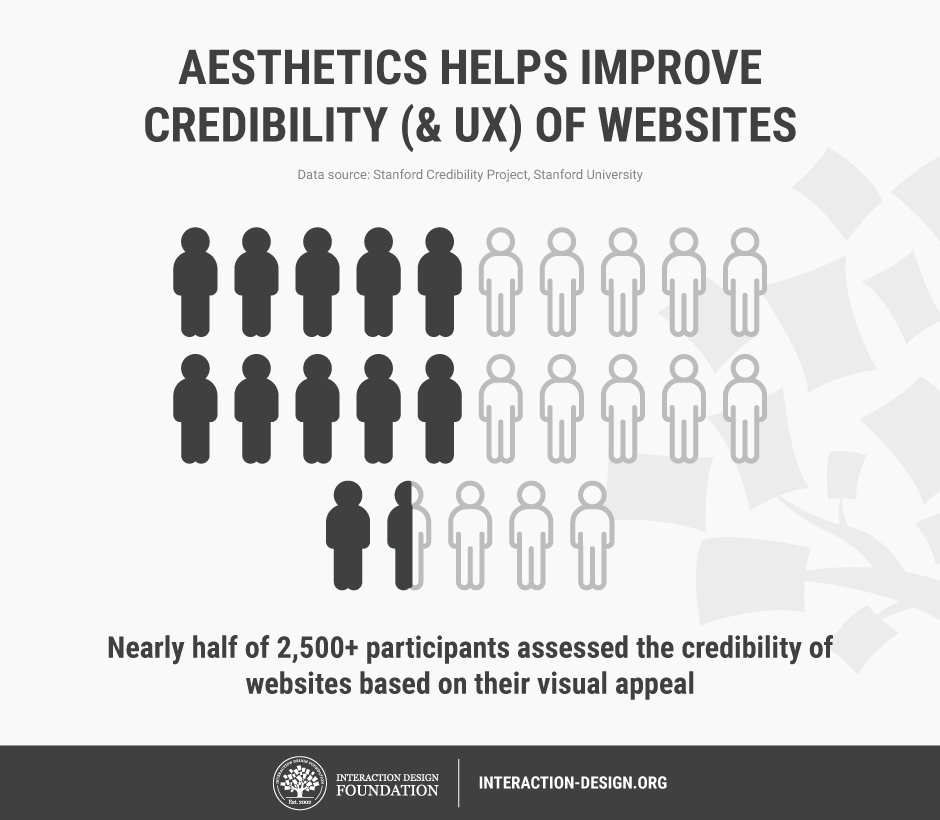
Moving from web design to UX design can sometimes be quite straightforward, especially if you’ve done some aspects of user research in your job as a web designer. For other web designers, however, there is no cause for concern. You’ll be able to make the leap if you’ve spent some time studying UX, practicing some UX skills during your web design work, and constructing a CV which shows your understanding of UX design. If you’re wondering where to learn, there are plenty of options available to you, and we’ve highlighted some of the best below.

Online Courses

Interaction Design Foundation

Don Norman, the cognitive scientist who coined the term “User Experience”, called the Interaction Design Foundation (yes, that’s us) a “goldmine of information on interaction design.” Forbes Magazine says that we offer “Ivy League level education in UX, Product Design or Human Computer Interaction.” Fortunately, that education isn’t at an Ivy League level of pricing. As a non-profit organization, we charge a low annual fee and you get access not just to all of our online learning, but also to the largest specialist design community in the world. We also offer a free library of academic texts from the design industry’s top researchers.

We have three courses (among our current offering of 32) that are specifically designed to help people enter the world of UX design. You’ll learn all areas of UX work and basic skills to practice UX work in Become a UX Designer from Scratch. In Get Your First Job as a UX (or Interaction) Designer, you’ll be able to learn what kinds of experience in UX do employers seek the most, as well as craft a winning cover letter, CV and portfolio that will help you get an interview for a UX design job. Finally, in User Research – Methods and Best Practices, learn the industry best practices of how to conduct proper user research and turn the results of your research into useful action on your product.

You can find all of our other UX courses here.

Coursera

You might also want to check out Coursera which is a great source of online learning. Their courses, like ours, are developed by leading experts in their field. Unlike us, however, they don’t specialize in UX and their courses aren’t always available, but when they are, they can either be accessed usually for a fee (on a per course basis).

Udemy

Udemy offers a huge selection of courses in nearly every subject area you can imagine. Udemy isn’t really a training provider, but rather a broker of training created by people from around the world. As such, there’s not much in the way of quality control applied to their courses—while some are absolutely brilliant, many are not.

Classroom Courses

Nielsen Norman Group

If you want to examine classroom courses; we recommend sticking with the “big names” of the industry who provide reliable and high-quality learning experiences. One of those big names is the Nielsen Norman Group who are also one of the best known UX consultancies; they offer a range of classroom based training at various locations around the world. They’re not inexpensive, but if you prefer not to have online training, they’re a good alternative.

You can find the Nielsen Norman Group’s training here.

Cooper

Cooper, a highly respected classroom-based training provider, also provides classroom courses on UX design. They’re also not cheap, but if you’re going to do classroom learning, it’s never going to be as cost-effective as online learning. They do, however, offer a nice range of locations to learn in as part of their service.

You can find more about Cooper’s training here.

University Courses

If you’ve got plenty of money and time, you could go ahead and get a Bachelor’s degree or a Master’s degree at a university. There isn’t, as of yet, a “UX-only” degree course, and the majority of related degrees tend to focus on Human Computer Interaction.

Two examples of this kind of program are:

Carnegie Mellon – HCI Programs

York University – MSc in HCI Technologies

University is not a low cost option, both in the sense of your time and money you’ll be spending on it. You’ll want to weigh up the pros and cons of a university course very carefully before you decide to go this route.

For instance, here’s how we break down the total costs of a 4-year un
iversity degree:

HSBC, as reported by Top Universities, found that the average US-based university education costs $36,564 a year(6). That includes tuition fees as well as living expenses. For a 4-year degree, this adds up to $146,256—and that’s not counting the costs (such as interest) of getting a loan for your studies.

Then there’s the opportunity cost of quitting work and spending four years at university. That is, the income you’ll forgo when studying full-time at a university. According to the United States Census, a non-graduate earns an average of $27,351 per year(7). Over 4 years, that amounts to $109,404 that could have been earned if you had been working.

Summing up the actual cost and opportunity cost gives you the total cost: a whopping $255,660!
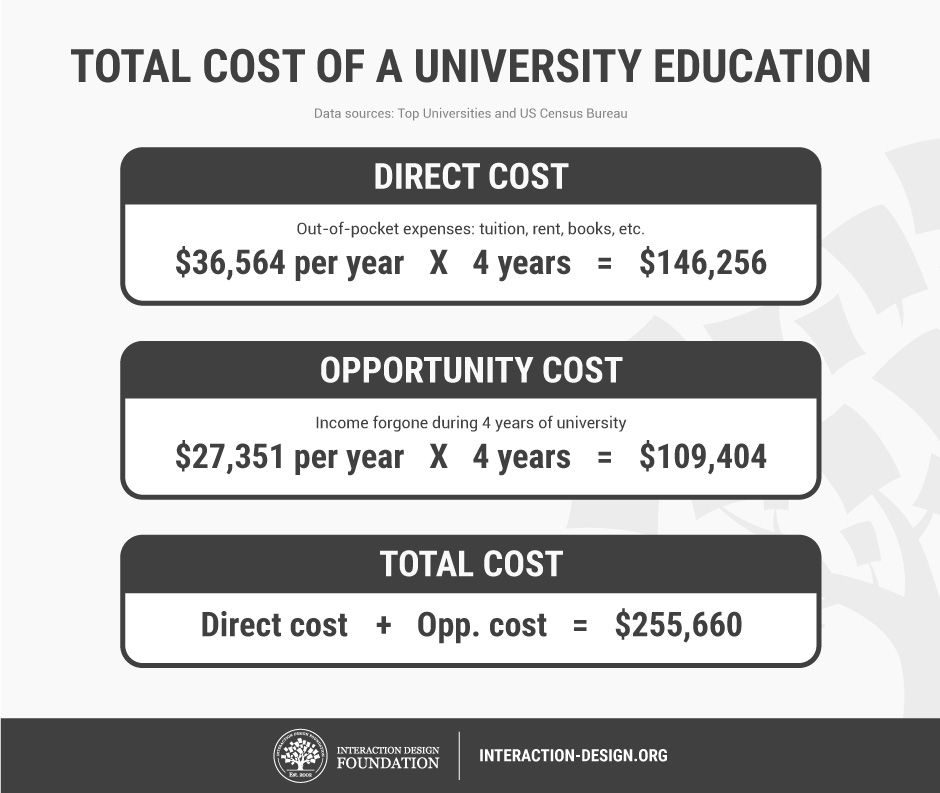
If you think that all the options are confusing, you might want start by examining the return on investment from each type of learning. We’ve got an article here that examines the return on investment from each of the learning types mentioned above.

Networking

The best way to find work in any field is to use a little inside knowledge and get some help from those people already doing what you want to do. This used to be hard work, but today you can simply get online and get networking.

We’d recommend LinkedIn to anyone looking to do some professional networking; join UX groups and join the conversation. Don’t just jump in and ask for work—demonstrate your value first and help people, and look for work only after you’ve built relationships.

The Interaction Design Foundation also offers networking opportunities to both members and non-members. Our members are able to carry out highly specific networking through pre-designed forums that allow for collaboration between large groups of designers. Both members and non-members can also attend our local groups’ community events, which are completely free to attend. You can find out more about the local groups here.

You could also think about getting involved with the design community’s leadership by interacting with them on social media. We’ve provided a list of twenty great designers here that you can interact with online; you can expand that list as much as you like with a little Google work.

Mentoring and Feedback

We’ve found that you can make a career change more easily if you can find someone to mentor you and provide feedback on your efforts. You can, of course, source a mentor from your existing professional network if you know someone who is happy to take the role on. If you think that’s not going to work for you, members of the Interaction Design Foundation’s Design League have access our network of UX design experts and see a mentor from that network.

The Take Away

It isn’t difficult to move from web design to UX design. You can build on your existing skills through a process of education and choose the kind of education that suits you best. Thereafter, you can put that learning into practice as a web designer. The good news is you already speak the language of design so once you have a little practice in UX, you’re going to be ready to transition your career into UX design and join the fastest growing part of the design profession in the world today.

References & Where to Learn More

  1. Course: Web Design for Usability:
    https://www.interaction-design.org/courses/web-design-for-usability
  2. Payscale’s research on Web Design salaries – http://www.payscale.com/research/US/Job=Web_Designer/Salary
  3. Payscale’s research on UX Design salaries – http://www.payscale.com/research/US/Job=UX_Designer/Salary
  4. CNN reports 3.4 million UX designer job growth in the next 10 years – http://money.cnn.com/pf/best-jobs/2012/snapshots/43.html
  5. DMI’s analysis of design investment – http://www.dmi.org/blogpost/1093220/182956/Design-Driven-Companies-Outperform-S-P-by-228-Over-Ten-Years–The-DMI-Design-Value-Index
  6. UX Myths: Aesthetics are not important if you have good usability – http://uxmyths.com/post/1161244116/myth-25-aesthetics-are-not-important-if-you-have-good-us
  7. How much does it cost to study in the US – http://www.topuniversities.com/student-info/student-finance/how-much-does-it-cost-study-us
  8. Earnings by education: US Census Bureau – https://www.census.gov/hhes/www/income/data/earnings/call1usboth.html

Changing careers isn’t as hard as it’s often made out to be, especially if you’ve got the right resources to help you make the change. For many web designers, now is the perfect time to make the switch into UX design. To start with, there’s the monetary boost that comes with the change in career. According to PayScale, web designers in the US earn an average of $46,000 annually(1), while UX designers on the other hand earn a sizeable $74,000(2). Secondly, job opportunities for UX designers are booming: CNN reports that a total of 3,426,000 UX design jobs will be created in the US alone within the next 10 years(3). Furthermore, UX design is a meaningful job, not only because you get to work on a product from the inside out, but also because—as DMI has shown—UX design makes a significant impact on businesses, with UX design-driven businesses outperforming the S&P index by 228%(4). So, where do you find the right resources to help you make your career change? Why, you’re reading one right now.

To start with, let’s have a brief introduction to what we mean by “User Experience”. Products have users, and the user experience (UX) is simply the experience a user has from using that particular product. So far, so good?

UX design is the art of designing products so that they provide the optimum possible user experience. If this description sounds broad, it’s because the nature of UX design is pretty broad. Building the optimum UX encompasses an understanding of psychology, interaction design, user research, and many other disciplines, but on top of it all is an iterative problem solving process (but more on that later).

Broadly speaking, user experience can be broken down into 3 components: the look, feel, and usability.

The look of a product is about using visuals to create a sense of harmony with the user’s values, and that creates credibility and trust with the user. It’s about creating a product that not only looks nice, but looks right too.

The feel, then, involves making the experience of using a product as pleasant and enjoyable as possible. It’s built by crafting the interactions between the user and the product, as well as the reactions they have when (and after
) using the product.

Lastly, usability underpins the user experience. Quite simply, if a product isn’t usable, no amount of good looks can salvage it, and the only feeling users are going to have is anger and frustration. Ideally, products should be personalized to user’s needs, and deliver functionality in a predictable way.

If you’re still not sure whether UX design appeals to you, we’ve got some articles that help introduce some of the important parts of UX as a career:

An Introduction to Usability

Usability vs Desirability

What is Interaction Design?

What Do Web Design and UX Design Have in Common?

The job title “Web Designer” has many definitions, and indeed, what a web designer does is largely dependent on what the client or project requires. Some web designers simply create visual designs and/or high fidelity interactive prototypes of the website, and leave the coding of the website to front-end and back-end developers. The majority of web designers, however, do get involved with both the designing and (front-end) development of the website. Some web designers even regularly do user research and testing as part of their jobs (and if you’re one of them, you’re already almost ready for a job in UX design).

But no matter what your job as a web designer entails, here are some aspects of web design that can also be found in UX design.

Problem solving

Web designers look to solve problems for their clients; UX designers look to solve problems for their users. Web designers work with a problem solving process: first, they find out the problems their clients have, then design a web solution for them, and then proceed to develop and test the website before releasing it. And after a website is launched, web designers often are involved with further testing the site, collecting feedback from users, and then reiterating on the design.

This iterative problem solving process is similar to the UX design process (shown in the image below). UX designers begin with user research; it’s essential to get to know the potential users of a product and find out what their problems are, how to solve them and how to make users want and/or need that solution. User research is often done via user interviews, observations, demographic studies, drafting user stories and personas, etc. Thereafter, UX designers would create a design solution that solves the user’s key needs, and often bring the prototype back to users to test its validity or usability. After the product is launched, UX designers collect more user feedback, which feeds into a new round of user research, thereby starting the process again.

If you’ve done user research before as part of your web designer job, you will find it a great advantage when making the switch to UX design. If not, don’t worry—you’ll have many opportunities to learn the best ways to conduct user research (read on to find out more).

Emotional design

When designing websites, web designers often make use of typography, color and layout to shape the emotions of users. A sense of credibility could be established, for instance, by using darker colors and serif fonts; similarly, a sense of fun could be created using colorful imagery and playful typography. Web designers are familiar with emotional design; that is, creating designs that elicit emotions from users. UX designers are also concerned with emotional design, but on a larger scale—they are concerned with eliciting emotions from users throughout their entire experience of using a product.

To do that, UX designers work with not only typography and color, but also psychology, motion design, content curation and information architecture. Web designers making the change would innately understand what emotional design in UX entails; they simply need to pick up new knowledge in other areas to augment their ability to do so on a bigger picture.

Multi-disciplinary

Web design is a multi-disciplinary job, where you’d need not only knowledge in design (typography, color theory) but also skills in developing a website (HTML, CSS, JavaScript). Some web designers are also involved in interaction design when they code for animations and interactions using CSS and/or JavaScript. UX design is also a multi-disciplinary field, but perhaps supercharged in that sense. UX designers need to make use of knowledge from the areas of psychology, user research, visual design, and even business to create the best UX for their products.

The Differences between Web Design and UX Design

User-focused vs technology-focused

A large part of your job as a web designer is spent on catching up on the latest developments in HTML, CSS and other coding languages—all of which change and improve at a dizzying pace. Which browsers support what versions of CSS? Would CSS animations work in Safari on a Mac? Don’t even get me started on Internet Explorer! These might be a few questions (and frustrations) that are constantly on your mind as a web designer.But UX design isn’t concerned with technology. Instead, its focus is centered squarely on users—technology is only a means for users to get what they need. Only by focusing on users can UX designers create solutions that cater to the specific needs they have, and ultimately, that users will be willing to pay for. UX designers do extensive user research to find out the most they can about their users, most of which the majority of web designers wouldn’t have had the chance to perform.

UX is more than the web

UX design is platform independent. Its principles and processes are applied to many diverse areas outside of web browsers: on mobile apps, desktop software, and even hardware products and retail spaces. On the other hand, the domain of web design is strictly tied to web browsers. This means that UX designers are able to find job opportunities not only in up-and-rising fields like tech startups, but also in mature and stable industries like car manufacturers. As long as there’s a product, there’s a need for UX—and this really opens up your world of opportunities.

The Big Benefit of Web Design Experience when Moving to UX Design

Relevance of web design background

The biggest benefit of moving from web design to UX design is the amount of overlap between the two fields of design. While it’s true that UX design covers more platforms than the web browser, a sizeable portion of UX design work is still done on products that are at least partially web-based (think of social media websites like Facebook and Twitter, web apps like Dropbox, and services like Google). The overlap between web design and UX design is greater if you’ve done some form of user research or iterative process of continually improving a website with user data.

Being fluent in design and website coding terminologies will also give you a boost that cannot be ignored; after all, UX design is a collaborative process where communication is crucial. Being able to use industry terms while talking to your colleagues will definitely put you in a better place than someone who came from a non-design background.

Aesthetics

Your ability to create beautiful aesthetics as a web designer will also come in handy when making the switch to UX design. Firstly, aesthetics is a great tool to augment your communications with internal stakeholders. As a UX designer, you have to constantly present your findings and recommendations to internal stakeholders (such as the CEO or product manager), and your ability to create visually pleasing reports and presentations will maximize the absorption of your key points.

Secondly, aesthetics plays a vital role in UX design.
A common myth of UX design is that great usability trumps aesthetics—but that is far from true. In fact, a study of more than 2,500 participants by the Stanford Credibility Project showed that nearly half of them assessed the credibility of websites based on their visual appeal(5). This goes to show how aesthetics works hand in hand with other factors like usability to bring about the optimum user experience of using a product.

Moving from web design to UX design can sometimes be quite straightforward, especially if you’ve done some aspects of user research in your job as a web designer. For other web designers, however, there is no cause for concern. You’ll be able to make the leap if you’ve spent some time studying UX, practicing some UX skills during your web design work, and constructing a CV which shows your understanding of UX design. If you’re wondering where to learn, there are plenty of options available to you, and we’ve highlighted some of the best below.

Online Courses

Interaction Design Foundation

Don Norman, the cognitive scientist who coined the term “User Experience”, called the Interaction Design Foundation (yes, that’s us) a “goldmine of information on interaction design.” Forbes Magazine says that we offer “Ivy League level education in UX, Product Design or Human Computer Interaction.” Fortunately, that education isn’t at an Ivy League level of pricing. As a non-profit organization, we charge a low annual fee and you get access not just to all of our online learning, but also to the largest specialist design community in the world. We also offer a free library of academic texts from the design industry’s top researchers.

We have three courses (among our current offering of 32) that are specifically designed to help people enter the world of UX design. You’ll learn all areas of UX work and basic skills to practice UX work in Become a UX Designer from Scratch. In Get Your First Job as a UX (or Interaction) Designer, you’ll be able to learn what kinds of experience in UX do employers seek the most, as well as craft a winning cover letter, CV and portfolio that will help you get an interview for a UX design job. Finally, in User Research – Methods and Best Practices, learn the industry best practices of how to conduct proper user research and turn the results of your research into useful action on your product.

You can find all of our other UX courses here.

Coursera

You might also want to check out Coursera which is a great source of online learning. Their courses, like ours, are developed by leading experts in their field. Unlike us, however, they don’t specialize in UX and their courses aren’t always available, but when they are, they can either be accessed usually for a fee (on a per course basis).

Udemy

Udemy offers a huge selection of courses in nearly every subject area you can imagine. Udemy isn’t really a training provider, but rather a broker of training created by people from around the world. As such, there’s not much in the way of quality control applied to their courses—while some are absolutely brilliant, many are not.

Classroom Courses

Nielsen Norman Group

If you want to examine classroom courses; we recommend sticking with the “big names” of the industry who provide reliable and high-quality learning experiences. One of those big names is the Nielsen Norman Group who are also one of the best known UX consultancies; they offer a range of classroom based training at various locations around the world. They’re not inexpensive, but if you prefer not to have online training, they’re a good alternative.

You can find the Nielsen Norman Group’s training here.

Cooper

Cooper, a highly respected classroom-based training provider, also provides classroom courses on UX design. They’re also not cheap, but if you’re going to do classroom learning, it’s never going to be as cost-effective as online learning. They do, however, offer a nice range of locations to learn in as part of their service.

You can find more about Cooper’s training here.

University Courses

If you’ve got plenty of money and time, you could go ahead and get a Bachelor’s degree or a Master’s degree at a university. There isn’t, as of yet, a “UX-only” degree course, and the majority of related degrees tend to focus on Human Computer Interaction.

Two examples of this kind of program are:

Carnegie Mellon – HCI Programs

York University – MSc in HCI Technologies

University is not a low cost option, both in the sense of your time and money you’ll be spending on it. You’ll want to weigh up the pros and cons of a university course very carefully before you decide to go this route.

For instance, here’s how we break down the total costs of a 4-year university degree:

HSBC, as reported by Top Universities, found that the average US-based university education costs $36,564 a year(6). That includes tuition fees as well as living expenses. For a 4-year degree, this adds up to $146,256—and that’s not counting the costs (such as interest) of getting a loan for your studies.

Then there’s the opportunity cost of quitting work and spending four years at university. That is, the income you’ll forgo when studying full-time at a university. According to the United States Census, a non-graduate earns an average of $27,351 per year(7). Over 4 years, that amounts to $109,404 that could have been earned if you had been working.

Summing up the actual cost and opportunity cost gives you the total cost: a whopping $255,660!

If you think that all the options are confusing, you might want start by examining the return on investment from each type of learning. We’ve got an article here that examines the return on investment from each of the learning types mentioned above.

Networking

The best way to find work in any field is to use a little inside knowledge and get some help from those people already doing what you want to do. This used to be hard work, but today you can simply get online and get networking.

We’d recommend LinkedIn to anyone looking to do some professional networking; join UX groups and join the conversation. Don’t just jump in and ask for work—demonstrate your value first and help people, and look for work only after you’ve built relationships.

The Interaction Design Foundation also offers networking opportunities to both members and non-members. Our members are able to carry out highly specific networking through pre-designed forums that allow for collaboration between large groups of designers. Both members and non-members can also attend our local groups’ community events, which are completely free to attend. You can find out more about the local groups here.

You could also think about getting involved with the design community’s leadership by interacting with them on social media. We’ve provided a list of twenty great designers here that you can interact with online; you can expand that list as much as you like with a little Google work.

Mentoring and Feedback

We’ve found that you can make a career change more easily if you can find someone to mentor you and provide feedback on your efforts. You can, of course, source a mentor from your existing professional network if you know someone who is happy to take the role on. If you think that’s not going to work for you, members of the Interaction Design Foundation’s Design League have access our network of UX design experts and see a mentor from that network.

The Take Away

It isn’t difficult to move from web design to UX design. You can build on your existing skills through a process of education and choose the kind of education that suits you best. Thereafter, you can put that learning into practice as a web designer. The good news is you already speak the language of design so once you have a little practice in UX, you’re going to be ready to transition your career into UX design and join the fastest growing part of the design profession in the world today.

References & Where to Learn More

  1. Course: Web Design for Usability:
    https://www.interaction-design.org/courses/web-design-for-usability
  2. Payscale’s research on Web Design salaries – http://www.payscale.com/research/US/Job=Web_Designer/Salary
  3. Payscale’s research on UX Design salaries – http://www.payscale.com/research/US/Job=UX_Designer/Salary
  4. CNN reports 3.4 million UX designer job growth in the next 10 years – http://money.cnn.com/pf/best-jobs/2012/snapshots/43.html
  5. DMI’s analysis of design investment – http://www.dmi.org/blogpost/1093220/182956/Design-Driven-Companies-Outperform-S-P-by-228-Over-Ten-Years–The-DMI-Design-Value-Index
  6. UX Myths: Aesthetics are not important if you have good usability – http://uxmyths.com/post/1161244116/myth-25-aesthetics-are-not-important-if-you-have-good-us
  7. How much does it cost to study in the US – http://www.topuniversities.com/student-info/student-finance/how-much-does-it-cost-study-us
  8. Earnings by education: US Census Bureau – https://www.census.gov/hhes/www/income/data/earnings/call1usboth.html

Source

Skip to content