
Secure Your Business with Leading Cybersecurity in Houston

Secure Your Business with Leading Cybersecurity in Houston

Cybersecurity professionals monitoring security data in a modern office setting

Leading-Edge Cybersecurity Services in Houston — Managed IT Security to Fortify Your Business

Houston companies are confronting an escalating wave of sophisticated cyber risks that can cripple operations, expose sensitive customer data, and trigger substantial regulatory penalties. This guide elucidates the landscape of managed IT security for Houston SMBs, maps the local threat environment, and connects practical managed services to the concrete risks your organization encounters. You’ll gain insights into why professional cybersecurity is paramount in critical sectors like energy, healthcare, and manufacturing, which managed controls address specific attack vectors, and how to satisfy evolving requirements such as TXDPSA, HIPAA, PCI DSS, GDPR, and CCPA. We delve into core services—next-gen endpoint protection, unified firewall management, continuous vulnerability orchestration, rapid incident response, and business continuity—and demonstrate how continuous 24/7 monitoring and focused controls significantly lower the probability of a breach. Continue for clear next steps, quick-reference tables for leaders, and actionable guidance for selecting a Houston-managed security partner.

Why Do Houston Businesses Need Proactive Cybersecurity Services?

Proactive cybersecurity mitigates breach risk, accelerates threat detection, and sustains operational continuity by integrating continuous monitoring, advanced technical controls, and defined response protocols into a managed program. Houston’s diverse ecosystem of energy, healthcare, port, and manufacturing firms creates high-value targets where an outage can precipitate safety hazards and substantial financial losses. Recent threat intelligence indicates SMBs bear a disproportionate financial and operational burden post-breach, underscoring that resilient defenses and auditable controls are paramount to limit exposure and meet regulatory expectations. The section below lists the most common threats for Houston SMBs and links each one to mitigation a managed provider can deliver.

Houston businesses should prioritize professional cybersecurity for three clear reasons:

  • To minimize the financial and operational fallout from sophisticated cyberattacks against key local industries.
  • To ensure regulatory adherence and contractual compliance through robust technical and governance controls.
  • To accelerate threat detection and incident response, thereby reducing dwell time and expediting recovery.

Those priorities make the connection between specific threats and service decisions obvious. The table that follows pairs common threats with mitigation priorities.

Local threats differ in how they attack operations and data, and each requires specific controls.

Threat TypeLikelihood for SMBsRecommended Mitigation
RansomwareHighImmutable backups, next-gen endpoint detection & response (EDR), network micro-segmentation
Phishing / BECVery HighSecurity awareness training, advanced email security gateways, multi-factor authentication (MFA), anti-phishing EDR rules
Insider ThreatModerateLeast-privilege access, comprehensive security logging, privileged access management (PAM)
Supply Chain AttacksIncreasingVendor risk assessments, continuous vulnerability orchestration, third-party risk monitoring

What Are the Most Critical Cyber Threats Facing Houston SMBs?
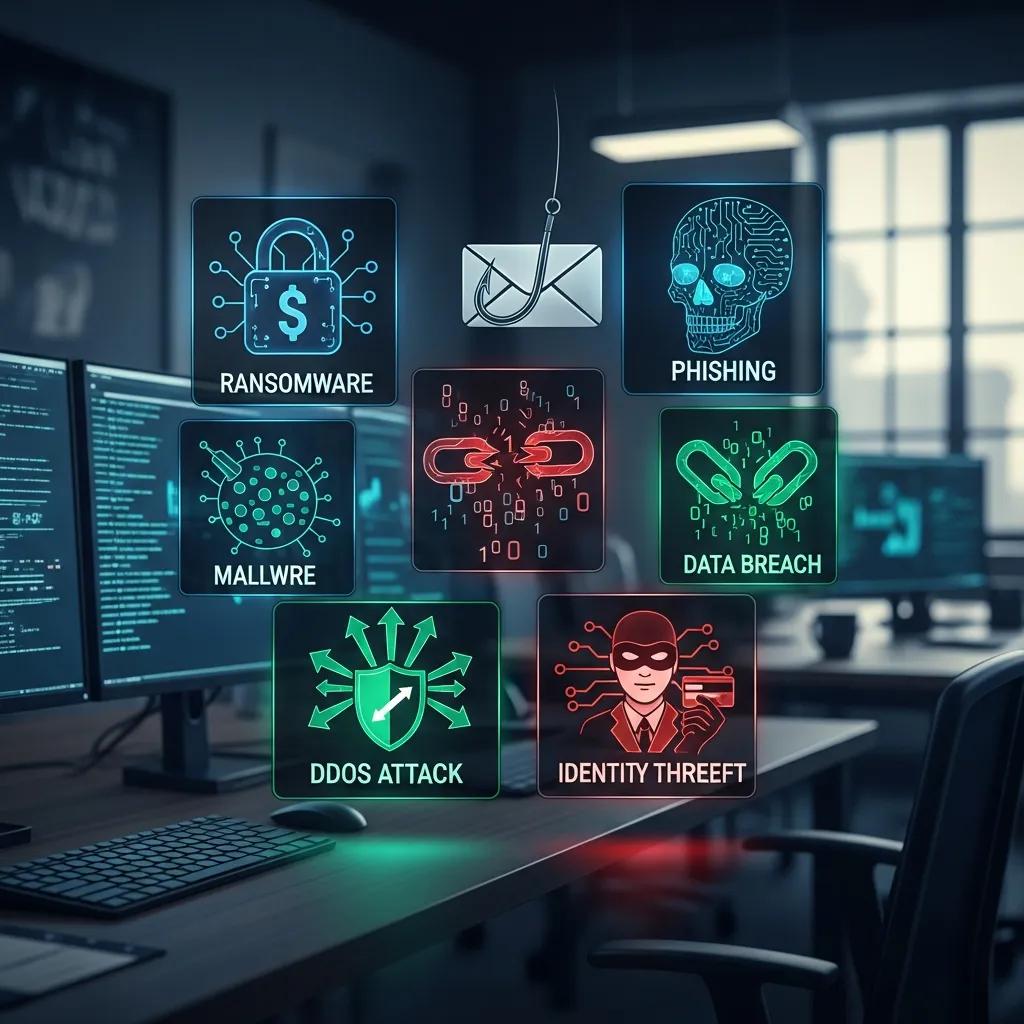
Illustration of common cyber threats such as ransomware and phishing affecting businesses

Ransomware, sophisticated phishing (including Business Email Compromise – BEC), insider threats, and supply chain vulnerabilities represent the most critical cyber risks for Houston SMBs due to their high impact and relatively simple entry points. Ransomware can cripple critical infrastructure and cause weeks of downtime; phishing and BEC remain primary initial access vectors. Insider threats—both negligent and malicious—exploit weak access controls to compromise sensitive data, and supply chain attacks leverage vulnerabilities within third-party software or vendor ecosystems. A multi-layered defense is paramount: advanced EDR and immutable backups for ransomware, comprehensive email security and security awareness training for phishing, granular role-based access controls for insider threats, and continuous third-party risk management for supply chain resilience.

Those threat profiles should directly shape the managed services you prioritize from a provider; we outline those services next.

How Do Data Protection Regulations Impact Houston Companies?

Evolving data protection regulations such as TXDPSA, HIPAA, PCI DSS, GDPR, and CCPA mandate comprehensive risk assessments, robust technical safeguards, stringent breach notification protocols, and meticulous documentation that affect Houston organizations across industries. Compliance commonly demands encryption, granular access controls, comprehensive security logging, incident response plans, and up-to-date policies with supporting evidence. Non-compliance can result in substantial penalties, legal liabilities, and reputational damage, so treating regulatory duties as operational priorities is essential. Initiate with a compliance gap analysis, then implement prioritized technical controls and maintain audit-ready evidence for reporting.

Meeting these obligations typically needs continuous monitoring, documented processes, and vendor support so your organization can produce the evidence required during investigations or audits. The following section shows which managed services deliver that capability.

What Managed Cybersecurity Services Does Precise Business Solutions Offer in Houston?

Precise Business Solutions is a leading Houston-based provider of comprehensive IT support, managed services, and strategic IT consulting for small and medium-sized enterprises (SMEs). We offer proactive threat intelligence, accelerated incident response, continuous vulnerability orchestration, next-gen endpoint detection and response (EDR), unified firewall management, robust data encryption, and compliance enablement for HIPAA, GDPR, PCI DSS, CCPA, and ISO 27001. Our managed security services integrate 24/7 monitoring, advanced detection, and rapid response capabilities, augmenting your in-house resources to significantly reduce dwell time and ensure stringent service-level agreements (SLAs) for incident remediation. Below is a concise list of core managed services and an executive-friendly table that summarizes attributes and business value.

Our core managed cybersecurity offerings encompass:

  • Next-generation endpoint protection and EDR to proactively identify and neutralize sophisticated threats across workstations and servers.
  • Unified firewall and network security solutions to enforce granular access controls, prevent lateral movement, and optimize traffic flows.
  • Continuous vulnerability assessment and automated patch management to rapidly remediate exploitable weaknesses.

These services are delivered via a modern Security Operations Center (SOC) model, ensuring 24/7 threat monitoring and streamlined incident response workflows.

Delivering effective cybersecurity to SMBs is challenging—often because budgets and staff are limited while threats keep getting more complex.

Managed Detection and Response (MDR) for SME Cybersecurity Challenges

Small and medium-sized enterprises (SMEs) make up the majority of businesses worldwide but are often underserved in cybersecurity due to constrained budgets, limited staffing, and increasingly sophisticated attackers. Managed Detection and Response (MDR) has emerged as a critical solution for these organizations. However, architecting a profitable, scalable 24/7 MDR service for SMEs presents unique challenges: optimizing cost-effectiveness while ensuring comprehensive coverage, leveraging intelligent automation without compromising human expertise, and developing modular detection capabilities that remain accessible.

MDR service design: Building profitable 24/7 threat coverage for SMBs, 2025
ServiceKey AttributeBusiness Value
Next-Gen EDRProactive EDR & behavioral analyticsMinimizes breach surface and contains lateral threat propagation
Unified Firewall ManagementNext-Gen Firewall (NGFW) & centralized policy orchestrationRobust perimeter defense and minimized attack surface
Vulnerability OrchestrationContinuous vulnerability assessment & automated remediationReduced exploitability and enhanced compliance posture

How Does Managed Endpoint Protection Fortify Your Business?

Managed endpoint protection leverages real-time behavioral analytics, signatureless detection, and automated containment to proactively neutralize threats before widespread propagation. A sophisticated EDR platform ingests endpoint telemetry, correlates anomalous activities, and automatically isolates compromised devices, alerting SOC analysts for swift remediation. That approach limits lateral movement, shortens dwell time, and protects backups for swift recovery. Integrating EDR with vulnerability management and centralized security information and event management (SIEM) establishes a closed-loop defense, mitigating re-infection risks and preserving forensic evidence for regulatory compliance.

Endpoint protection is a foundational control that enables broader SOC operations and disaster-recovery planning.

What Are the Benefits of Unified Firewall Management and Network Security?

Unified firewall management centralizes rule sets, security logging, and policy enforcement across distributed environments, minimizing misconfigurations and eliminating visibility gaps. Next-Generation Firewalls (NGFWs), Intrusion Detection/Prevention Systems (IDS/IPS), and micro-segmentation collaboratively block advanced threats, detect anomalous traffic patterns, and contain breaches within isolated network segments. Centralized policy orchestration lowers administrative overhead and ensures consistent enforcement for businesses with multiple locations—important for Houston firms with distributed operations. Aggregated visibility and comprehensive logging provide the critical telemetry required for effective incident response and regulatory audits.

Network controls complement endpoint protections and create layered defenses that materially reduce risk and response times.

How Can Houston Businesses Ensure Data Protection and Regulatory Compliance?

Checklist showing compliance actions for data protection in a business setting

Robust data security and regulatory compliance necessitate harmonized technical controls, comprehensive policies, and audit-ready evidence demonstrating continuous adherence to industry standards. Start with a full assessment, then prioritize remediation, formalize documentation, and put recurring monitoring in place to prove controls are working. Pivotal technical measures include encryption for data at-rest and in-transit, multi-factor authentication (MFA), least-privilege access principles, and comprehensive security logging to support stringent breach notification timelines. The short checklist below lists immediate steps every Houston SMB can take to begin meeting obligations.

A practical three-step compliance roadmap:

  • Assess: Conduct a comprehensive compliance gap analysis against relevant frameworks and prioritize identified risks.
  • Remediate: Implement targeted technical and administrative controls based on the prioritized risk profile.
  • Monitor & Document: Establish continuous security monitoring, maintain immutable evidence, and regularly refine your incident response plan.

Following this sequence helps businesses build defensible controls and maintain readiness for reporting and audits.

Compliance StandardKey MandatePrecise Solutions Enablement
HIPAAPHI safeguards, breach notification protocols, and privacy controlsCompliance assessments, control orchestration, continuous monitoring, and audit reporting
PCI DSSCardholder data environment (CDE) protection and granular loggingMicro-segmentation, robust encryption, and SIEM integration for audit readiness
GDPR / CCPAData subject rights management and expedited breach notificationData inventory mapping, consent management, and incident response orchestration

Which Data Encryption Methods Protect Sensitive Business Information?

Encryption renders sensitive data unintelligible without authorized cryptographic keys, significantly mitigating exposure in the event of a system compromise. Data at-rest encryption (e.g., disk or file-level AES) secures stored records, while data in-transit protections (e.g., TLS/SSL) safeguard information during transfer. Robust key management—encompassing secure generation, regular rotation, and protected storage of cryptographic keys—is paramount to encryption efficacy. Managed services can orchestrate encryption policy enforcement across hybrid cloud and on-premise environments, ensuring timely key and certificate rotation and auditability.

Strong encryption combined with access controls and logging is a core compliance control auditors expect to see implemented and monitored.

How Does Precise Business Solutions Support HIPAA, GDPR, PCI DSS, and Other Standards?

We deliver comprehensive compliance assessments, strategic remediation planning, policy framework development, and continuous monitoring aligned with evolving regulatory mandates. Our integrated services—encompassing proactive threat intelligence, accelerated incident response, continuous vulnerability orchestration, next-gen EDR, unified firewall management, robust data encryption, and compliance enablement for HIPAA, GDPR, PCI DSS, CCPA, and ISO 27001—directly align with auditor expectations for risk assessments, technical safeguards, comprehensive logging, and demonstrable incident response capabilities. Continuous managed monitoring and reporting simplify audit prep and help sustain continuous compliance.

Embedding compliance into daily operations reduces audit friction and enables faster, evidence-backed responses when incidents occur.

Why Choose Precise Business Solutions for Cybersecurity in Houston?

Selecting the optimal cybersecurity partner requires a provider that integrates deep local industry acumen with service models tailored for SME budgets and scalability requirements. At Precise Business Solutions, we prioritize integrated IT and security operations, proactive 24/7 threat monitoring, flexible and scalable service tiers, responsive expert support, and profound compliance expertise. These core strengths translate into enhanced operational resilience, streamlined audit processes, and optimized total cost of ownership for Houston enterprises. The list below highlights core differentiators to evaluate when choosing a managed security partner.

Key differentiators to consider when evaluating providers:

  • Local Industry Vertical Expertise: Tailored solutions addressing the unique regulatory and operational demands of Houston’s energy, healthcare, and manufacturing sectors.
  • Proactive 24/7 Threat Monitoring: Continuous threat detection and predictive analytics to minimize operational disruptions.
  • Scalable SME Service Tiers: Flexible service packages designed for business growth, underpinned by transparent Service Level Agreements (SLAs).
FeatureCharacteristicClient Benefit
Converged IT & SecurityHolistic managed IT and cybersecurity servicesStreamlines vendor ecosystems and harmonizes IT/security strategic roadmaps
24/7 Security Operations Center (SOC)Real-time threat intelligence and rapid incident orchestrationAccelerates threat containment and minimizes business disruption
Compliance EnablementProactive assessment and audit-ready reportingSimplifies audit processes and validates regulatory adherence

If your Houston business needs a partner that pairs advanced technical controls with practical operational experience, Precise Business Solutions delivers managed services and responsive support tailored to local needs. For inquiries or to arrange a security health check, call Precise Business Solutions at (281) 612-1133.

Frequently Asked Questions

What are the most critical cyber threats impacting Houston businesses?

Ransomware, sophisticated phishing (including BEC), and supply chain vulnerabilities are the predominant threats. Ransomware can lock critical systems and demand payment, phishing often gives attackers an initial foothold, and supply chain compromises exploit vendors and third-party software. Knowing which threats are most likely for your business helps you prioritize defenses that prevent the most damaging outcomes.

How can organizations quantify the efficacy of their cybersecurity posture?

Monitor key performance indicators (KPIs) such as threat detection rates, Mean Time To Detect (MTTD), Mean Time To Respond (MTTR), and the success rate of security awareness training simulations. Routine vulnerability assessments, penetration testing, and compliance audits further validate security posture. Together, these metrics and assessments show whether controls are working and where to focus improvement.

What is the strategic imperative of data encryption in modern cybersecurity?

Encryption safeguards data at-rest and in-transit by rendering it unintelligible without authorized cryptographic keys, thereby minimizing data exposure during a breach. Robust encryption practices—coupled with stringent key management—are often mandated by regulatory frameworks like HIPAA and GDPR, forming a cornerstone of a resilient security program.

What is the immediate protocol for organizations experiencing a data breach?

Execute a well-rehearsed incident response plan: contain the breach, conduct a thorough scope and impact assessment, fulfill all mandatory breach notification obligations, and initiate remediation. Perform a comprehensive root-cause analysis, enhance security controls to prevent recurrence, and meticulously document all actions for regulatory bodies and stakeholders. Rapid containment and clear communication minimize damage and legal exposure.

How can Houston's small and medium-sized enterprises (SMEs) access affordable cybersecurity solutions?

SMEs can optimize costs by opting for flexible, tiered managed security service packages aligned with their specific risk profile and budgetary constraints. Cloud-native security solutions, shared Security Operations Center (SOC) services, and prioritizing high-impact controls (e.g., EDR, MFA, immutable backups) provide robust protection without significant capital expenditure. Frame cybersecurity as strategic risk management—a proactive investment that preempts exponentially higher breach-related costs.

What is the strategic significance of continuous monitoring in modern cybersecurity?

Continuous monitoring facilitates real-time threat detection and accelerated response by perpetually analyzing network telemetry, user behavior analytics (UBA), and system vulnerabilities. This proactive security posture shrinks the attacker’s operational window, supports stringent compliance obligations, and significantly enhances an organization’s overall cyber resilience.

Conclusion

Proactive cybersecurity is indispensable for Houston enterprises aiming to mitigate evolving risks, fulfill stringent regulatory mandates, and ensure uninterrupted business operations. Managed IT security delivers specialized expertise, continuous threat intelligence, and auditable controls that fortify cyber resilience and significantly reduce the probability of financially impactful breaches. By comprehending the nuanced local threat landscape and aligning security services strategically, organizations can make informed decisions and elevate their overall security posture. For a detailed assessment of your security needs, contact Precise Business Solutions today.

Tailored Legal Tech Solutions for Your Law Firm’s Success

Tailored Legal Tech Solutions for Your Law Firm's Success

Legal professionals collaborating in a modern office with technology and cybersecurity elements

Managed IT Services for Law Firms: Tailored IT Solutions to Strengthen Security, Maintain Compliance, and Improve Efficiency

Managed IT for law firms means outsourcing day-to-day technology operations to specialists who deliver proactive security, reliable continuity, and practice-aware IT governance. This guide outlines what a tailored managed IT program looks like for legal teams, why law firms need industry-specific controls, and how a strategic IT approach lowers risk while enabling secure remote work, smooth integrations with case-management and document systems, and predictable operating costs. You’ll find clear explanations of core cybersecurity controls (MFA, encryption, EDR), cloud deployment options that suit legal workflows, and support and disaster-recovery practices designed to limit lost billable hours. We map technical measures to compliance drivers like ABA confidentiality duties and common privacy frameworks, show practical integration patterns, and give concise comparison tables and summaries to help managing partners and CIO-level readers prioritize investments in law office security and managed IT.

Why Are Managed IT Services Essential for Legal Firms?

Managed IT services matter for law firms because they combine continuous monitoring, compliance-focused controls, and operational reliability to protect privileged information and keep billable work moving. Outsourcing to specialists ensures consistent patching, backups, and threat detection—reducing breach risk and expensive downtime that threaten client confidentiality and revenue. A tailored managed IT program also simplifies vendor coordination and tightens integration between case management and document systems, cutting duplicated work and smoothing collaboration. Together, these capabilities deliver defensive value (fewer incidents) and operational value (faster recovery and better workflow), supporting firm growth while meeting ethical obligations.

At Precise Business Solutions, we design managed IT specifically for legal practices. Our services emphasize proactive monitoring, predictive maintenance, and scalable support. We pair dedicated response models with certified technicians who align technical controls to regulatory priorities, consolidate services for cost efficiency, and build long-term, client-focused partnerships.

How Do Managed IT Services Improve Law Firm Security and Compliance?

Close-up of a cybersecurity dashboard as a legal professional reviews documents

Managed IT raises security and compliance through layered technical controls, continuous monitoring, and governance that directly support professional duties and regulatory requirements. Core practices include enforced multi-factor authentication, disk and transport encryption, endpoint detection and response (EDR), and centralized logging to preserve auditable trails for incident investigations.

Those controls reduce credential theft, keep sensitive documents protected in transit and at rest, and provide documented evidence of reasonable safeguards during audits or disciplinary inquiries. Regular patch management and vulnerability scanning close common attack paths, and clear policies plus staff training mitigate human risk—supporting privacy frameworks and ABA technology guidance.

This layered approach naturally prompts questions about how specific controls affect compliance. The next section offers a concise comparison of common cybersecurity controls and the protections they provide.

Beyond compliance, the controls above reduce recurring interruptions to client service, and they feed directly into incident response and disaster-recovery planning.

What Operational Challenges Do Legal Practices Face Without Tailored IT Support?

Without IT tuned for legal work, firms frequently suffer downtime, fragmented software stacks, insecure remote access, and uneven data protection that all harm client service and professional obligations. Preventable outages cost billable hours, delay filings, and erode trust. Disconnected tools create duplicate entry and version-control headaches that slow staff productivity. Weak remote access or poor access controls increase the risk of credential theft and accidental disclosure of privileged material. Lacking formal backup and recovery plans, firms can face prolonged outages with unclear recovery targets, creating compliance and malpractice exposure.

Resolving these challenges requires a coordinated mix of technical controls, integration planning, and support SLAs that prioritize legal workflows and measurable recovery objectives—topics we cover in the cloud and support sections that follow.

How Does Cybersecurity Protect Law Firms from Data Breaches and Compliance Risks?

Cybersecurity reduces a firm’s attack surface, detects anomalies quickly, and documents response actions that satisfy notification and audit requirements. Identity controls, encryption, endpoint protections, and centralized logging create multiple barriers to data exfiltration and generate the forensic records regulators expect. Regular incident-response planning and tabletop exercises help contain events fast and preserve client confidentiality while limiting regulatory and reputational harm. Below are the primary defensive measures firms should prioritize.

  • Multi-Factor Authentication (MFA): Adds a second verification step to prevent credential misuse.
  • Encryption (at rest and in transit): Keeps emails and files unreadable if intercepted or stolen.
  • Endpoint Detection & Response (EDR): Detects suspicious behavior and enables rapid containment of endpoint threats.
  • Centralized Logging / SIEM: Correlates events, supports audits, and speeds incident detection.

These controls form the core defensive posture; mapping them to compliance requirements and exercising response plans completes an effective program.

Intro to EAV table: The table below compares common cybersecurity controls, what they protect, and their primary compliance impact for law firms.

ControlProtectsCompliance Impact
Multi-Factor Authentication (MFA)User accounts and credential-based takeoverShows strong access control and reasonable safeguards
Encryption (at rest & in transit)Confidential documents and communicationsSupports data-protection obligations and breach mitigation
Endpoint Detection & Response (EDR)Malware, ransomware, and lateral movementEnables timely detection and documented containment
Centralized Logging / SIEMEvent correlation and an auditable trailProvides evidence for incident response and regulatory reporting

Using these controls together yields stronger protection than relying on any single measure—each fills gaps the others leave open.

Precise Business Solutions implements MFA, encrypted backups, EDR, and compliance-focused controls mapped to common privacy frameworks and ethical guidance. Our delivery emphasizes measurable controls and audit-ready documentation so firms can demonstrate due care.

Law Firm Cybersecurity Risks: Staying Compliant and Protected

Law firms are increasingly targeted by cyberattacks, making proactive security and compliance essential. As the cybersecurity market grows, firms must stay current with threats and regulations to protect sensitive client data and maintain operational integrity. Understanding evolving risks and matching them with practical safeguards reduces exposure and supports professional responsibilities. Law firms must manage cybersecurity risks, 2017

What Are the Key Cybersecurity Measures for Legal Data Protection?

Protecting legal data depends on practical controls that cover authentication, confidentiality, endpoint resilience, and human factors. Enforcing MFA on externally accessible systems prevents most account-takeover attempts. End-to-end encryption keeps privileged documents confidential during sharing and storage. EDR identifies suspicious workstation and server behavior so teams can isolate compromised devices before attackers move laterally. Complementary practices—timely patching, least-privilege access, and role-based controls—further shrink exposure and produce auditable policies that support compliance.

Together, these technical and procedural measures create an incident-ready practice, provided they’re paired with regularly tested response and recovery plans to preserve continuity when incidents occur.

Law Firm Cybersecurity: Protecting High-Value Client Data

A firm’s security is only as strong as its weakest link. Law firms hold high-value digital communications and client files that attract a range of adversaries using both advanced and low-tech methods. As electronic records and mobile devices proliferate, the threat landscape grows—making robust controls and continuous vigilance critical to protecting intellectual property, sensitive corporate records, and litigation materials.

Law Firm Cybersecurity, DB Garrie, 2024

How Do Legal IT Solutions Ensure Compliance with HIPAA, GDPR, and ABA Guidelines?

Legal IT solutions turn regulatory and ethical requirements into actionable technical controls, policies, and documented procedures. For HIPAA/GDPR-style obligations that means controls like access management, encryption, breach notification workflows, and data-subject procedures where applicable. For ABA guidance it means safeguarding client confidentiality through secure communication, proper file handling, and evidence of technology competence. Detailed logs, change records, and incident timelines create the audit trail regulators expect. Regular audits, employee training, and policy reviews keep technical controls aligned with evolving obligations and make compliance defensible.

Mapping controls to specific duties and preserving proof of implementation reduces compliance risk and supports ethical practice.

Intro to cloud comparisons: Choosing the right cloud solutions deployment affects security, accessibility, and cost; the table below summarizes common options for legal workloads.

Deployment ModelSecurity CharacteristicOperational Trade-off
Private cloud / dedicated hostingStrong tenant isolation and customizable controlsHigher cost and greater configuration effort
Hybrid cloudFlexible placement of sensitive workloadsRequires careful integration and governance
Hosted desktops / VDICentralized desktop control and data containmentResource-intensive but reduces endpoint risk

Choose a model based on data sensitivity, integration needs with document management, and your recovery objectives.

Precise Business Solutions offers secure cloud hosting and integrations with common practice- and document-management systems so firms can scale while preserving workflow compatibility and single sign‑on patterns.

Digital Legal Documentation & Case Management: Cybersecurity Challenges

This review examines how digitization of legal documentation and case management affects workflows and security. Drawing on multidisciplinary research, it highlights the rise of electronic case management systems and the cybersecurity challenges that accompany digital transformation—emphasizing the need for secure integrations and robust controls across legal technologies. LEGAL DOCUMENTATION AND CASE MANAGEMENT: A SYSTEMATIC REVIEW OF DIGITIZATION TRENDS AND CYBERSECURITY CHALLENGES IN LEGAL …, 2023

What Cloud Solutions Are Best Suited for the Legal Industry?

Cloud computing concept for legal industry with legal icons over an office backdrop

Cloud options for law firms balance secure hosting, integration with legal software, and predictable recovery outcomes. Private or dedicated hosting gives stronger isolation for highly sensitive matters. Hybrid setups let firms keep critical data on isolated infrastructure while using public cloud for less-sensitive workloads. Hosted desktops and VDI centralize control of sessions so documents don’t land on unmanaged endpoints and policies can be enforced consistently. The right choice depends on access patterns, integration requirements with case and document systems, and budget trade-offs.

Picking the appropriate model helps firms protect confidentiality without blocking remote collaboration.

How Does Secure Cloud Hosting Enable Remote Access for Attorneys?

Secure cloud hosting enables remote work through centralized session environments, conditional access policies, and session logging to maintain confidentiality. VDI or hosted desktops provide controlled workspaces where files remain on managed infrastructure rather than on personal devices. Conditional access checks device posture and location, while session auditing and file-activity logs preserve traceability for matters. Applying zero-trust principles reduces implicit trust for remote connections and lets attorneys work offsite without exposing privileged data.

These controls support hybrid practice patterns while helping firms meet their ethical and regulatory duties.

Which Legal Practice Management Software Integrates Seamlessly with Cloud Services?

Most practice and document management systems integrate with cloud platforms using APIs, single sign-on (SSO), and secure connectors that sync matters, documents, and billing data. Common patterns include SSO for centralized authentication, API-based metadata synchronization for workflow automation, and connector-driven backups to include documents in recovery plans. To ensure smooth operation, validate connector support, encryption in transit, and retention policies so case workflows remain intact during outages or migrations.

Well-designed integrations reduce manual work and support business continuity—especially when paired with reliable backups.

How Can Legal IT Support Services Optimize Law Firm Productivity and Continuity?

Legal IT support improves productivity and continuity by providing responsive helpdesk coverage, clear SLAs, and tested disaster-recovery plans that prioritize billable-hour preservation and client service. Key elements include 24/7 monitoring and escalation, rapid remote-remediation tools, defined RTO/RPO targets for critical systems, and regular DR testing. Proactive monitoring cuts incident frequency, and virtual CIO services help align technology decisions with firm strategy and regulatory needs. Together these capabilities reduce downtime, stabilize operations, and let legal teams focus on client matters.

Below is a concise comparison of support features, their attributes, and the operational benefits they deliver.

Support FeatureAttributeOperational Benefit
24/7 HelpdeskContinuous monitoring and responseLess downtime, preserved billable hours
SLA & EscalationDefined response and resolution targetsPredictable remediation and clear accountability
RTO/RPO-backed BackupsEncrypted offsite replicationMeasurable recovery time and reduced data loss
Virtual CIOStrategic planning and vendor coordinationIT aligned to business goals and budget

What 24/7 IT Support Features Are Critical for Legal Practices?

Critical 24/7 support features include a helpdesk that understands legal workflows, clear escalation paths to on-site technicians, remote remediation tools, and prioritized SLAs for urgent legal tasks. A law-aware helpdesk can triage incidents by their impact on filings and deadlines; remote remediation reduces the need for dispatch; escalation protocols ensure high-severity events get immediate attention; and scheduled maintenance windows limit surprises. Together these features protect billable time and client relationships during incidents.

Effective support models pair these capabilities with measurable KPIs and regular reviews to continually improve response and resolution.

How Does Data Backup and Disaster Recovery Protect Legal Firms from Downtime?

Backups and disaster recovery translate risk into action by defining recovery objectives, keeping encrypted offsite copies, and regularly testing restore procedures. Good strategies set RTO (time to restore) and RPO (acceptable data loss), use immutable backups to resist ransomware, and run DR drills to validate procedures under pressure. Offsite replication and geographically separate restore points reduce correlated risk, and documented recovery playbooks speed restoration and client notifications. Regular testing and recordkeeping keep recovery plans realistic and aligned with professional responsibilities.

These practices make downtime manageable and support continuous client service.

When continuity is a priority, Precise Business Solutions delivers 24/7 responsive support, disaster recovery planning, and scalable managed services built around legal workflows. To align RTO/RPO targets, SLAs, and testing cadence with your firm’s needs, schedule a consultation to assess requirements and next steps.

Frequently Asked Questions

What are the benefits of outsourcing IT services for law firms?

Outsourcing IT lets firms focus on legal work while relying on experts to manage technology, security, and compliance. A managed partner brings advanced cybersecurity, streamlined workflows, and 24/7 support—reducing downtime and improving client service. Outsourcing can also lower costs by avoiding the expense of in-house IT staff and infrastructure while providing predictable budgeting and access to specialized skills.

How can law firms assess their current IT security posture?

Start with a security audit that reviews policies, controls, and technologies: access management, encryption, backups, incident-response plans, and user training. Penetration testing and vulnerability scans by independent experts reveal hidden weaknesses. Regular audits against standards like ABA guidance, GDPR, or HIPAA (where applicable) help track progress and prioritize remediation.

What role does employee training play in legal IT security?

Training is essential. Regular, role-specific education helps staff spot phishing, handle sensitive data properly, and follow security protocols. Building a culture of security awareness reduces human error—the most common cause of incidents—and ensures everyone understands their part in protecting client information.

What should law firms consider when choosing a cloud service provider?

Evaluate security features, compliance posture, integration capabilities, and support. Confirm strong encryption, granular access controls, regular third-party audits, and a track record with legal customers. Check disaster-recovery plans, backup options, and contract flexibility so the provider supports your continuity and retention requirements.

How can law firms ensure compliance with evolving cybersecurity regulations?

Adopt a proactive compliance program: keep policies current, train staff, perform audits, and document controls. Monitor regulatory changes and involve legal and IT experts to map technical measures to obligations. Maintain logs and evidence of compliance activities to support defensible positions during inquiries or audits.

What are the signs that a law firm needs to upgrade its IT infrastructure?

Warning signs include frequent outages, slow systems, rising security incidents, and difficulty integrating new tools. If staff struggle to access files or collaborate, or if the firm can’t meet regulatory or recovery targets, it’s time to evaluate upgrades. Regular performance reviews and user feedback help detect these needs early.

Conclusion

Managed IT services are essential for modern law firms: they deliver targeted security, practical compliance support, and predictable operations so lawyers can focus on client work. With the right partner, you gain controls that protect privileged data, integrations that streamline workflows, and support that minimizes downtime. Precise Business Solutions helps firms design and operate managed IT programs that align with legal practice needs—reach out to explore how we can secure your practice and support your growth.

Skip to content