

Computer Basics Basic Troubleshooting Techniques

Lesson 19: Basic Troubleshooting Techniques

/en/computerbasics/creating-a-safe-workspace/content/

Troubleshooting

Do you know what to do if your screen goes blank? What if you can’t seem to close an application, or can’t hear any sound from your speakers? Whenever you have a problem with your computer, don’t panic! There are many basic troubleshooting techniques you can use to fix issues like this. In this lesson, we’ll show you some simple things to try when troubleshooting, as well as how to solve common problems you may encounter.

General tips to keep in mind

There are many different things that could cause a problem with your computer. No matter what’s causing the issue, troubleshooting will always be a process of trial and error—in some cases, you may need to use several different approaches before you can find a solution; other problems may be easy to fix. We recommend starting by using the following tips.

  • Write down your steps: Once you start troubleshooting, you may want to write down each step you take. This way, you’ll be able to remember exactly what you’ve done and can avoid repeating the same mistakes. If you end up asking other people for help, it will be much easier if they know exactly what you’ve tried already.
  • Take notes about error messages: If your computer gives you an error message, be sure to write down as much information as possible. You may be able to use this information later to find out if other people are having the same error.
  • Always check the cables: If you’re having trouble with a specific piece of computer hardware, such as your monitor or keyboard, an easy first step is to check all related cables to make sure they’re properly connected.
  • Restart the computer: When all else fails, restarting the computer is a good thing to try. This can solve a lot of basic issues you may experience with your computer.

Using the process of elimination

If you’re having an issue with your computer, you may be able to find out what’s wrong using the process of elimination. This means you’ll make a list of things that could be causing the problem and then test them out one by one to eliminate them. Once you’ve identified the source of your computer issue, it will be easier to find a solution.

Scenario:

Let’s say you’re trying to print out invitations for a birthday party, but the printer won’t print. You have some ideas about what could be causing this, so you go through them one by one to see if you can eliminate any possible causes.

First, you check the printer to see that it’s turned on and plugged in to the surge protector. It is, so that’s not the issue. Next, you check to make sure the printer’s ink cartridge still has ink and that there is paper loaded in the paper tray. Things look good in both cases, so you know the issue has nothing to do with ink or paper.

Now you want to make sure the printer and computer are communicating correctly. If you recently downloaded an update to your operating system, it might interfere with the printer. But you know there haven’t been any recent updates and the printer was working yesterday, so you’ll have to look elsewhere.

You check the printer’s USB cord and find that it’s not plugged in. You must have unplugged it accidentally when you plugged something else into the computer earlier. Once you plug in the USB cord, the printer starts working again. It looks like this printer issue is solved!

This is just one example of an issue you might encounter while using a computer. In the rest of this lesson, we’ll talk about other common computer problems and some ways to solve them.

Simple solutions to common problems

Most of the time, problems can be fixed using simple troubleshooting techniques, like closing and reopening the program. It’s important to try these simple solutions before resorting to more extreme measures. If the problem still isn’t fixed, you can try other troubleshooting techniques.

Problem: Power button will not start computer

  • Solution 1: If your computer does not start, begin by checking the power cord to confirm that it is plugged securely into the back of the computer case and the power outlet.
  • Solution 2: If it is plugged into an outlet, make sure it is a working outlet. To check your outlet, you can plug in another electrical device, such as a lamp.
  • Solution 3: If the computer is plugged in to a surge protector, verify that it is turned on. You may have to reset the surge protector by turning it off and then back on. You can also plug a lamp or other device into the surge protector to verify that it’s working correctly. resetting a surge protector
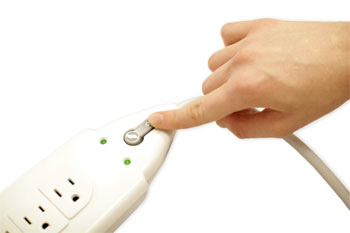
  • Solution 4: If you are using a laptop, the battery may not be charged. Plug the AC adapter into the wall, then try to turn on the laptop. If it still doesn’t start up, you may need to wait a few minutes and try again.

Problem: An application is running slowly

  • Solution 1: Close and reopen the application.
  • Solution 2: Update the application. To do this, click the Help menu and look for an option to check for Updates. If you don’t find this option, another idea is to run an online search for application updates. Checking for updates

Problem: An application is frozen

Sometimes an application may become stuck, or frozen. When this happens, you won’t be able to close the window or click any buttons within the application.

  • Solution 1: Force quit the application. On a PC, you can press (and hold) Ctrl+Alt+Delete (the Control, Alt, and Delete keys) on your keyboard to open the Task Manager. On a Mac, press and hold Command+Option+Esc. You can then select the unresponsive application and click End task (or Force Quit on a Mac) to close it. screenshot of Windows 8
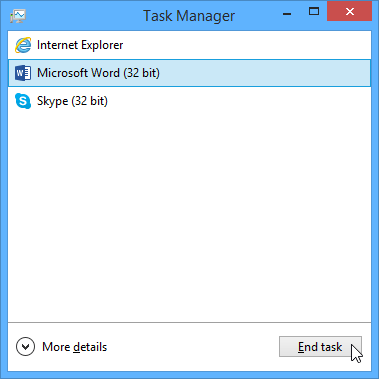
  • Solution 2: Restart the computer. If you are unable to force quit an application, restarting your computer will close all open apps.

Problem: All programs on the computer run slowly

  • Solution 1: Run a virus scanner. You may have malware running in the background that is slowing things down.
  • Solution 2: Your computer may be running out of hard drive space. Try deleting any files or programs you don’t need.
  • Solution 3: If you’re using a PC, you can run Disk Defragmenter. To learn more about Disk Defragmenter, check out our lesson on Protecting Your Computer.

Problem: The computer is frozen

Sometimes your computer may become completely unresponsive, or frozen. When this happens, you won’t be able to click anywhere on the screen, open or close applications, or access shut-down options.

  • Solution 1 (Windows only): Restart Windows Explorer. To do this, press and hold Ctrl+Alt+Delete on your keyboard to open the Task Manager. Next, locate and select Windows Explorer from the Processes tab and click Restart. You may need to click More Details at the bottom of the window to see the Processes tab. screenshot of Windows 8
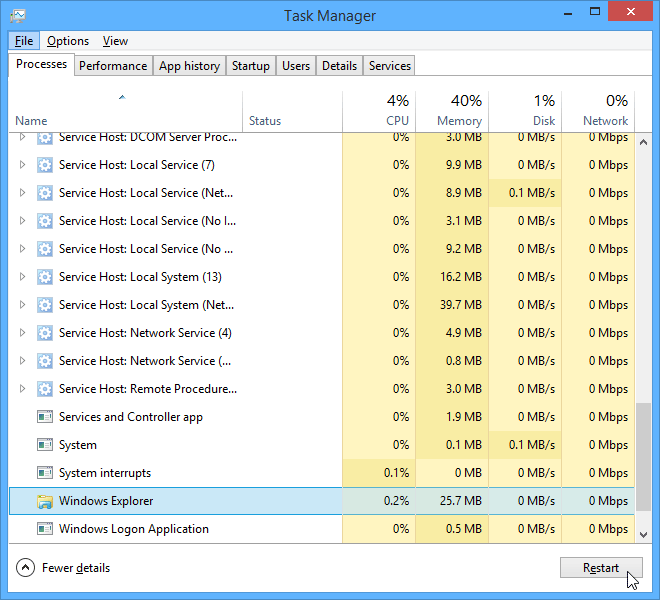
  • Solution 2 (Mac only): Restart Finder. To do this, press and hold Command+Option+Esc on your keyboard to open the Force Quit Applications dialog box. Next, locate and select Finder, then click Relaunch. screenshot of OS X
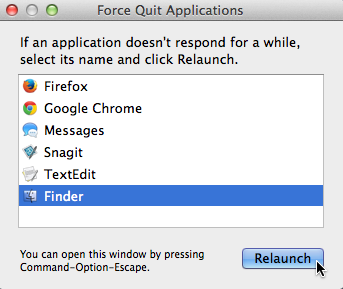
  • Solution 3: Press and hold the Power but
    ton. The Power button is usually located on the front or side of the computer, typically indicated by the power symbol. Press and hold the Power button for 5 to 10 seconds to force the computer to shut down.
  • Solution 4: If the computer still won’t shut down, you can unplug the power cable from the electrical outlet. If you’re using a laptop, you may be able to remove the battery to force the computer to turn off. Note: This solution should be your last resort after trying the other suggestions above.

Problem: The mouse or keyboard has stopped working

  • Solution 1: If you’re using a wired mouse or keyboard, make sure it’s correctly plugged into the computer.
  • Solution 2: If you’re using a wireless mouse or keyboard, make sure it’s turned on and that its batteries are charged.

Problem: The sound isn’t working

  • Solution 1: Check the volume level. Click the audio button in the top-right or bottom-right corner of the screen to make sure the sound is turned on and that the volume is up.
  • Solution 2: Check the audio player controls. Many audio and video players will have their own separate audio controls. Make sure the sound is turned on and that the volume is turned up in the player. screenshot of iTunes

  • Solution 3: Check the cables. Make sure external speakers are plugged in, turned on, and connected to the correct audio port or a USB port. If your computer has color-coded ports, the audio output port will usually be green.
  • Solution 4: Connect headphones to the computer to find out if you can hear sound through the headphones.

Problem: The screen is blank

  • Solution 1: The computer may be in Sleep mode. Click the mouse or press any key on the keyboard to wake it.
  • Solution 2: Make sure the monitor is plugged in and turned on.
  • Solution 3: Make sure the computer is plugged in and turned on.
  • Solution 4: If you’re using a desktop, make sure the monitor cable is properly connected to the computer tower and the monitor.

Solving more difficult problems

If you still haven’t found a solution to your problem, you may need to ask someone else for help. As an easy starting point, we’d recommend searching the Web. It’s possible that other users have had similar problems, and solutions to these problems are often posted online. Also, if you have a friend or family member who knows a lot about computers, they may be able to help you.

google screenshot

Keep in mind that most computer problems have simple solutions, although it may take some time to find them. For difficult problems, a more drastic solution may be required, like reformatting your hard drive or reinstalling your operating system. If you think you might need a solution like this, we recommend consulting a professional first. If you’re not a computer expert, it’s possible that attempting these solutions could make the situation worse.

/en/computerbasics/how-to-use-your-computers-builtin-help/content/

Source

Tools for Building Backlinks

WEBINAR:
On-Demand

Desktop-as-a-Service Designed for Any Cloud ? Nutanix Frame

Backlinks are links created on other sites that link to your site. As such, you don’t always know when they are created. In a previous article, “So You Want Backlinks,” guidelines were given on backlink building. When it comes time to build backlinks, you don’t have to do everything from scratch. Rather, you can analyze your site’s URLs, determine what backlinks already exist, and tap into existing best practices for link building, which improves your search engine optimization (SEO).

More importantly, a lot of bad practices were mentioned in the previous article. These were practices that can hurt your site including getting links from spammy sites, having broken links to your site, and more. Find these potential toxic backlinks on other sites can be easy if you have the right tool! In fact, there are a number of tools that can help you work with backlinks.

A Caution on Backlinks and Tools

In addition to helping you structure backlinks, they can also help you with suggestions on backlinks you should ask to be removed. Automated tools are not perfect. You should review any suggestions to remove (or even keep) backlinks. There are times when it might make sense to keep a link that is flagged as having an issue. There might also be times when a tool doesn’t catch that a link really isn’t appropriate.

There are tools that focus specifically on backlinking. There are also SEO tools that have sections focused on backlinking as part of a larger overall SEO approach. Both types of tools can be effective. The key benefit of the tools is to get a list of existing backlinks to your site or a page on your site as well as to get insights on the benefit or toxicity of each link. If the tool can help you with getting links removed, that can be a benefit as well.

You want to avoid tools that offer to build automatic backlinks for you.

The Backlinking Tools

The following are four tools that can be used to identify and manage backlinks. These are tools that have been identified as useful for backlink analysis. There is a brief description of each of these below.

  • SEMRush
  • AHrefs
  • Open Site Explorer
  • OpenLinkProfiler

Note that there are a multitude of other tools marketed for backlink analysis and building. Many of the tools suggested to me for this article included features for selling backlinks, building automated backlinks, and for tracking backlink trades. As such, they were dropped from this article. These are bad practices, and thus worth avoiding.

Backlink Tool 1: SemRush

SEMRush provides a multitude of tools including a Backlink Audit tool that will give you deep insights into the links coming to your site. You can configure it to look at backlinks in a number of ways as well see individual backlinks. In addition to providing data such as backlink types, domain distribution, top anchors, country sources, and a list of linking domains, SEMRush also provides a toxicity score for each backlink that lets you know the potential for negative impact.

Basic features of SEMRush can be used at no cost.


Figure 1: SemRush Backlink data for MSN.com

Backlink Tool 2: AHrefs

Ahrefs is another of the more popular SEO tools known for its backlink tools. Ahrefs provides competitive analysis, keyword research, backlink research. Within the backlink data, you can get information on the new and broken backlinks, referring domains, anchor tags, top referring content, and more.

Ahrefs is not a free tool, but they do provide a low-cost trial.


Figure 2: Ahref backlink data for HTMLGoodies.com

Backlink Tool 3: Open Site Explorer

Open Site Explorer is a part of the Moz Pro SEO tools. Like the previous two tools mentioned, Open Site Explorer provides tools to help you identify and optimize your backlink strategy. This includes showing backlinks to your site, providing spam scores, showing a spam score (similar to SEMRush’s toxicity score) for links, and more. Open Site Explorer helps you identify which of your pages are most valuable, which domains are best of those linking to your site, what text is being used to build the links, and more. It also provides linking opportunities and helps you to avoid penalties by showing you which links to clean up.

You can access a limited portion of Open Site Explorer’s functionality online. There is also a 30-day free trial. Otherwise, you need a subscription to Moz to continue to use the product.


Figure 3: Moz Open Site Explorer

Backlink Tool 4: OpenLinkProfiler

OpenLinkProfiler is a free online tool that can be used to do backlink analysis. You can go to the website as shown in Figure 4 and simply enter a site URL. Once you do, you’ll get a backlink analysis similar to what is shown in Figure 5.


Figure 4: OpenLinkProfiler page for entering a domain

As you can see in Figure 5, OpenLinkProfiler provides information on active links relative to the domain you entered. You can get anchor text, when the link was added as well as the industry and topic of some of the links. A Risk score similar to the toxicity and spam scores from other tools, can also be found to determine which links are potentially harmful. While SEOLink Profiler comes at no cost, to use some of the features, such as link notifications the exporting of a PDF report, you will need to set up a free account.


Figure 5: OpenLinkProfiler review of HTMLGoodies.com

Dealing with Bad Links

What do you do if you find bad backlinks on another site? There are generally two approaches that are taken. One is to ask that the link be removed. The other is to ask that the link be tagged with a ‘rel=nofollow’ tag. If a link already has a ‘rel=nofollow’ tag included, then no further action is really needed unless the site containing the link is really one you don’t want to be associated with.

Dealing with the removal of links to disavow them from your site is a process in itself that is worthy of its own article. In general, using a disavow tool should be a last resort for spammy backlinks. You can use the Google Search Console to disavow links. Additionally, most of the tools mentioned in this article not only show you how bad a backlink might be for your site, they generally include tools to help you disavow them as well. Look for an article on disavowing bad backlinks in the near future!

Source

10 of the most common computer problems with solutions

My Login Vault - Password Manager
In my line of work I get many calls about the below common problems and if I was to estimate I would say that at least 25% of them could be solved using the list below to troubleshoot the cause. Not only will this get you up and running quicker with a sense of achievement it will also save you the cost of a  technician coming out and charging you to just change a fuse for example. It could be that a cable has been accidentally pulled out or maybe your dog has chewed it all these things are worth checking before calling someone to take a look.

Just because your computer monitor won’t come on or your mouse won’t work does not mean that you have a virus or you need a new computer the solution could be much simpler. If you don’t find the solution here remember these are only very basic checks that all of us can forget to do before panicking about it been a more severe problem. It is not intended to be an advanced guide to computer problems but hopefully it will help before you decide what you need to do next.

error message common computer problems

Navigational shortcuts

fix common computer problemsPossible Solution/Cause

Computer will not startCheck all cables are plugged in and switches turned on.
Check monitor is turned on and plugged into the computer.
Change fuse in cable.Check extension if using one.
Try a different known working socket.
Change power lead.
Check no buttons or switches are stuck.
No sound coming from computerCheck that your speakers are on and plugged in
Check that the speaker is connected to the right port (Green to Green)
Check the volume is turned up
Check you don’t have sound muted (icon in taskbar)
Try plugging in ear phones to rule out broken speakers
Monitor screen blankCheck monitor is correctly connected
Check monitor is plugged in and turned on
Check connection to computer is not loose
Computer Boots but wont launch windowsCan you boot into safe mode? (F8 on start-up) if yes the problem is likely to be something software related rather than hardware.
Run malware, virus scans
If you can’t boot into safe mode try booting into your computers repair my computer mode to fix start-up issues
Try using system restore if you can boot to safe mode or recovery to restore to a previous date
Slow internetReboot your router and restart your computer (reboot router by unplugging and plugging back in after 5 minutes)
Check for malware and spyware infections.
Check there are no problems with your provider
Check other reasons for slow internet speeds here
Wireless connection droppingReboot both the computer and the router
Change the wireless channel
Move the router to a more central location
Extend your network using powerline adapters
Extend your wireless network with a Wireless N Range Extender
If your aerial is removable replace with a TP-Link TL-ANT2405C 2.4GHz 5dbi Indoor Omni-Directional Antenna or similar to increase range.
Mouse wont work or wont work correctlyEnsure mouse is connected correctly to the back of the computer.
If wireless change mouse batteries.
Ensure mouse is being picked up by receiver (likely a red button on bottom of mouse).
Check that receiver has not fallen out of range
Keyboard wont workCheck batteries in Keyboard
Check it is connected properly
Ensure it is being picked up by the receiver (red button on bottom)
No internet connection or Local onlyCheck all connections to router and that they are correctly plugged in
Check none of the cables are damaged
Restart router and restart computer
Check for red lights on the router (indicates there is a problem with the router)
Check all sockets have an ADSL filter connected
Change ADSL filters
Connect router to master phone socket
Check with service provider that your service is not disrupted
Try another router
Computer running very slow or sluggishCheck that no antivirus scans are running
Close some programs if running multiple programs
Malware and virus check
Low memory
Many more reasons with deeper explanations can be found at – Reasons for your computer running slow


Source

Skip to content