


Seamless cloud migration involves moving applications, data, and workloads from on‑premises or legacy systems to a cloud platform with minimal disruption and clear business outcomes. This guide outlines a structured migration strategy to minimize downtime, control costs, and enable scalable, faster delivery for businesses. It covers common migration patterns (the 6 Rs), governance, cost controls, and security, offering practical guidance for leaders planning a cloud move.
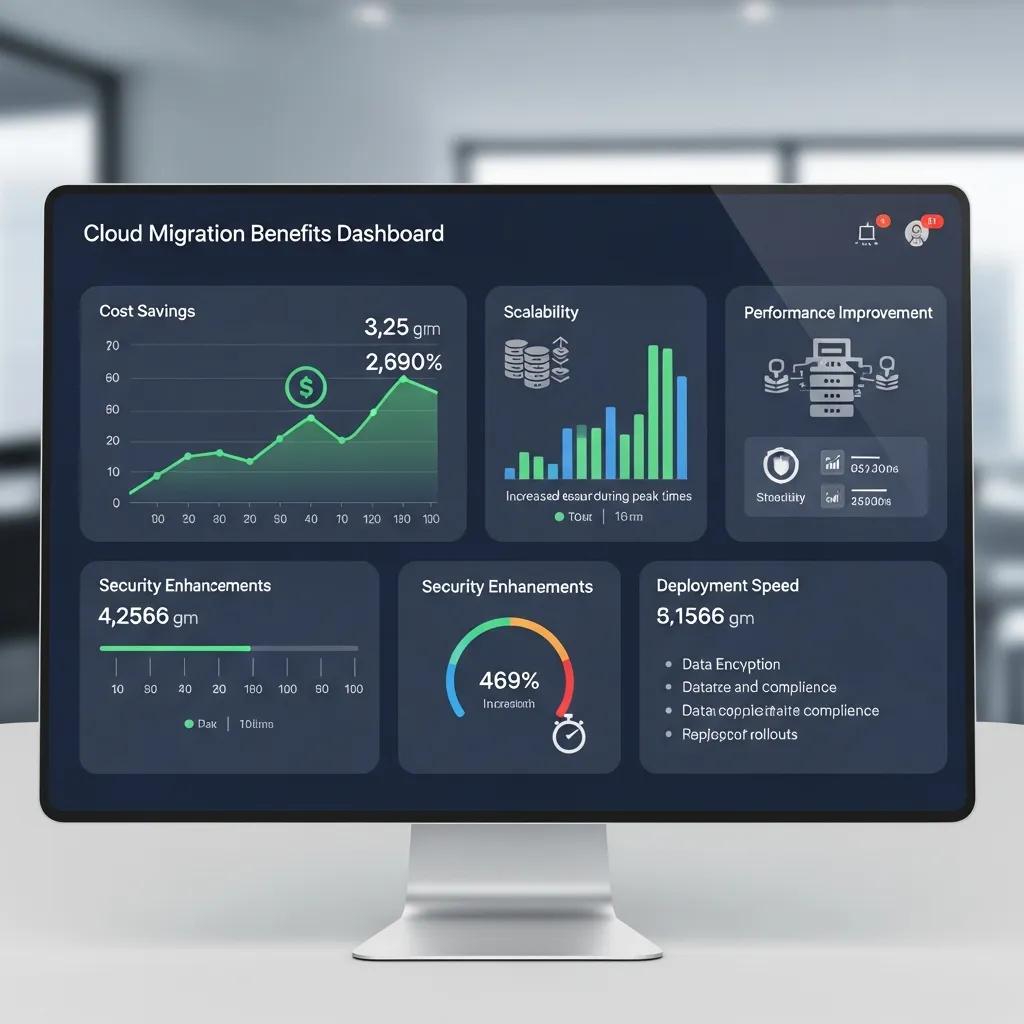
Correctly executed cloud migration lowers operating costs, provides elastic capacity, strengthens security, and improves business continuity by consolidating infrastructure onto managed cloud platforms. These gains stem from separating compute/storage, pay-as-you-go billing, centralized access, and automated backup. For decision-makers, this means faster time-to-market, clearer operational spend, and fewer outages. cloud solutions
Primary benefits for executives at a glance:
These improvements free IT teams to focus on innovation, shortening product cycles, and stabilizing operating budgets.
The table below helps leadership weigh cost, savings, and business impact.
| Benefit Category | Typical Savings/Metric | Business Impact |
|---|---|---|
| Cost Optimization | 10–30% operational savings (benchmark range) | Frees budget for innovation and reduces CAPEX |
| Scalability | Instant resource scaling | Supports variable demand without service delays |
| Business Continuity | Faster RTO/RPO (minutes to hours) | Minimizes revenue loss from outages |
This table aids executives in prioritizing migration based on ROI.
Precise Business Solutions offers tailored migration paths with proactive monitoring, 24/7 helpdesk, and a single point of contact, guiding assessment and execution to translate benefits into realistic budgets and timelines.
Effective Cloud Migration Approach for SMEs: From Consideration to Post-Migration
This paper outlines a practical approach to cloud migration for small and medium enterprises, covering steps from initial evaluation through post‑migration follow‑up. The framework is designed to guide organizations through cloud adoption while reducing risk and improving the chances of a smooth, measurable transition.
An effective approach to cloud migration for small and medium enterprises (SMEs), A Balobaid, 2020
Cloud migration unlocks scalability by decoupling capacity from hardware, allowing apps to consume elastic compute and storage on demand. Autoscaling, managed databases, and serverless components reduce overprovisioning while maintaining performance. Cost savings arise from shifting CAPEX to OPEX, pay-as-you-go pricing, reserved capacity, and continuous rightsizing via cost governance. Tagging, budgets, and automated scaling policies ensure measurable savings and aid forecasting.
Teams should begin with a phased assessment: inventorying workloads and dependencies to select a migration approach that avoids hidden operational costs.
Scalable Cloud Data Migration: Framework, Strategy, and Best Practices
This work describes a scalable framework for cloud data migration, detailing architecture and best practices applied across each phase of a migration. The methods help organizations achieve efficient transitions while aligning performance with strategic business goals through careful planning and execution.
Scalable Framework for Cloud Data Migration: Architecture,
Strategy and Best Practices, KC Batchu, 2025
Migration services strengthen security by centralizing IAM, standardizing encryption/patching, and enabling unified logging/monitoring. Continuity improves via automated backups, region-aware replication, and orchestrated disaster recovery, shortening RTOs. Managed detection, incident response playbooks, and regular vulnerability assessments reduce risk. Clear runbooks and tested failback plans ensure business continuity.
With these controls, teams can proceed with a practical, phased migration plan.
The migration follows discrete phases: assessment, strategy/planning, execution, validation/cutover, and post-migration optimization. Each phase has defined activities and deliverables, converting risk into actionable milestones and predictable timelines. This stepwise approach reduces downtime and manages contingencies. The list below outlines the end-to-end sequence.
These steps form the migration playbook. The table below maps deliverables and timelines for resource planning.
| Phase | Key Activities | Deliverables / Typical Timeline |
|---|---|---|
| Assessment | Inventory, dependency mapping, ROI analysis | Readiness report, prioritized workload list (1–3 weeks) |
| Planning | Architecture, migration pattern selection, cutover plan | Migration roadmap, test plans (2–4 weeks) |
| Execution | Data transfer, application migration, validation | Migrated workloads, validation reports (variable) |
Assessment and planning are critical. Precise Business Solutions provides migration assessments and strategic IT consulting, yielding clear roadmaps and prioritized recommendations. Their method focuses on dependency mapping, risk analysis, and transparent ROI estimates to inform executive decisions and technical cutover plans.
A full assessment inventories assets, maps interdependencies, and scores technical readiness/business priority to form migration waves. It classifies workloads by pattern (rehost, replatform, refactor, repurchase, retire, retain) and highlights sensitive data/compliance needs. Deliverables include a migration roadmap, cost-benefit analysis, and a cutover timeline with rollback criteria, reducing surprises and speeding validation.
Planning outputs directly inform secure migration tactics and the cutover sequence.
Teams choose migration patterns aligning with business goals: lift-and-shift for speed, replatforming for optimization, and refactoring for cloud-native modernization. Secure transport uses encrypted transfers, staging with integrity checks, and automated data validation. Rollback/fallback procedures are prepared, and parallel testing confirms performance before cutover. The right pattern balances speed, cost, and long-term benefits.
With proper validation and governance, organizations can complete cutover and focus on optimization.
Most migrations target major public cloud providers—AWS, Azure, and Google Cloud—each with distinct strengths. Platform choice depends on workload profile, existing licensing, and data/analytics priorities. Understanding each provider’s advantages helps match technical needs to business outcomes. The table below compares platforms and their ideal use cases.
| Platform | Strength | When to Use |
|---|---|---|
| AWS | Broad service ecosystem and maturity | Diverse workloads and deep service integration needs |
| Azure | Microsoft ecosystem and hybrid capabilities | Windows/.NET environments and existing Microsoft licensing |
| GCP | Data analytics and ML tools | Data-driven workloads and advanced analytics use cases |
AWS offers the largest set of managed services, ideal for complex, heterogeneous environments needing broad integration. Azure provides native ties to Microsoft products and strong hybrid tooling, suited for Windows and .NET investments. Google Cloud excels in data analytics, machine learning, and cost-efficient compute for data-heavy workloads. Match platform strengths to workload demands, compliance, and long-term vendor strategy for optimal cost and capability.
Selecting the right platform informs how service providers adapt migrations.
Precise Business Solutions assesses workload fit, mapping applications to platforms that best meet performance, compliance, and cost targets. Services include platform-specific configuration, governance, and post-migration tuning, preserving application behavior and access controls. They combine proactive monitoring, 24/7 helpdesk, custom scaling, and cost governance for efficient environments. This platform-aware approach reduces rework and speeds time to value.
Aligning platform selection and provider support simplifies subsequent security and compliance. Managed IT Insider
Security and compliance during migration rely on layered controls: encrypting data (in transit/at rest), applying least-privilege IAM, and continuous monitoring/logging for audit readiness. Migration plans map controls to regulatory requirements, documenting evidence and scheduling validations. Post-migration, managed security operations and disaster recovery maintain protection and continuity. The best practices below outline core controls for the migration lifecycle.
Key security best practices for migration include:
Applying these controls reduces breach risk and provides audit evidence for compliance.
Cloud Migration Strategies: Cost-Efficiency and Compliance Focus
This study emphasizes practical migration strategies that balance cost‑efficiency with compliance. Key takeaways include disciplined data classification, clear retention policies and role‑based access control — plus the importance of collaboration between IT and business stakeholders to keep migration objectives aligned with regulatory and budgetary constraints.
Developing Cloud Migration Strategies for Cost-Efficiency and Compliance, VR Thummala, 2024
Organizations can strengthen controls with managed security and resilience services. Precise Business Solutions includes managed security, disaster recovery, and compliance support, helping teams maintain protective controls and evidence collection. This operational support sustains compliance, speeds recovery, and offers a single point of contact.
Best practices blend preventive, detective, and responsive controls: enforce encryption, apply least-privilege IAM, run continuous vulnerability scans, and maintain immutable backups. Integrate logging into a SIEM for detection, and use runbooks/tabletop exercises to validate response readiness. Regular configuration reviews and automated compliance checks enforce guardrails, building a defensible security posture for audits and operational resilience.
Meeting standards like HIPAA and GDPR requires mapping cloud controls to regulatory obligations, documenting shared-responsibility, and retaining audit evidence. Migration plans must specify data locations, protection, access authorities, and include retention/deletion processes for privacy rules. Post-migration validation and audit support confirm technical and procedural compliance. Organizations should expect evidence artifacts and configuration baselines for ongoing compliance.
These compliance steps complete the migration lifecycle, preparing organizations for secure, cost-effective cloud operations.
Timelines vary based on infrastructure complexity, typically ranging from weeks to several months. Phases include assessment, planning, execution, and optimization. Assessment and planning usually take 3–7 weeks, with execution depending on application/data complexity. Thorough planning and staging are crucial for schedule adherence and minimal disruption.
Common challenges include data loss, unplanned downtime, and legacy application compatibility. Inaccurate inventories or missed dependencies can cause delays and costs. Security and compliance during transition also add complexity. Mitigation involves thorough discovery, risk assessment, selecting the right migration pattern, and partnering with experienced providers.
Ensure data integrity with encrypted transfers, integrity checks during staging, and automated validation. Conduct comprehensive pre-migration tests and maintain backups. Post-migration, compare source and destination datasets with reconciliation checks. Document the process and preserve logs for auditability.
Employee training is essential for operating and securing the new cloud environment, understanding new processes, and following updated runbooks. Tailored training reduces errors and accelerates adoption, with ongoing resources supporting cloud service management and optimization post-cutover.
Measure success using pre-defined KPIs: cost savings, application performance, reduced downtime, scalability, and user satisfaction. Track post-migration operational metrics against baselines. Regular reviews against goals allow for adjustments to configurations, governance, and cost controls to achieve intended business outcomes.
Cloud migration shifts IT focus from hardware maintenance to cloud service management, security, and optimization. While routine infrastructure tasks may require fewer staff, demand for cloud, security, and data skills increases, often necessitating retraining or new hires. This enables IT to act more strategically, supporting innovation and business alignment.
Seamless cloud migration offers cost efficiency, scalable capacity, and stronger security, fostering innovation and improving continuity. With a clear process and expert support, decision-makers can navigate complexity to realize full cloud benefits. Explore tailored migration plans matching your goals. Contact Precise Business Solutions for a practical, low-risk path to an agile, resilient cloud environment.